Thursday, December 30, 2010

Volk/Watson Christmas Extravaganza 2010: Heavenly Hosts


The Spread

"Heavenly Hosts", aka the 3rd Annual Volk/Watson Christmas Extravaganza can be described as follows:
A selection of dishes with divinity in mind. From the angel food cake to Philadelphia cream cheese sundried tomato spread, each recipe has heavenly associations (ex: the Philadelphia cream cheese commercials) and is fit for angels. Of course, not all angels can digest dairy, so there are always alternatives, even healthier alternatives for all those eco-friendly angels. The "raw" dips are not heated above a certain temperature, are vegan, and are made with nuts soaked in water to remove digestive enzyme inhibitors, for any inhibited angels. Then there are the "Land of Milk and Honey" dishes (ironically, naturally dairy-free) - the Prosecco zabaione (Italian custard) and melomakarona (Greek semolina cookies soaked in honey syrup).
The other dishes are the personal heavens of the Volk/Watson family.

My dad's heaven: pork vindaloo
My mom's heaven: dairy-free, gluten-free dark chocolate hazelnut torte
My brother's heaven: Well my brother likes most things, and I refuse to make sushi with farmed antibiotic-laden Atlantic salmon (unsustainable, at that) so I've created a heaven for him of baguette (the manna of heaven) with Quebec Oka cheese, caramelized onions, smoked herring, crab, and fig jam. That way he can mix and match.

My heaven? Saag. Indian spinach. It's sweet and slippery and delicious. The onions, mustard seeds and asafoetida are amazing, and wrap it up in a fermented rice and lentil dosa and I'm a happy, happy person.
Here are the pictures. The rest of the food included daifuku (Japanese red bean desserts that I broiled), chicken mochi with a sweet soy-sesame dipping sauce (soy and szechuan peppercorn studded meatballs wrapped in savoury rice pastry), frozen grapes (what's heaven without branches of grapes?), home-made caramel (life - and death - are not worth living without caramel), and bottles of natural wines (again, grapes). I think that was everything? Here's most of it in pictures:
Sundried Tomato Cream Cheese Spread, Quebec Oka Cheese, grapes and pistachios

3 "Raw" Dips: Macademia Nut Ricotta, Basil Walnut Dip, Sundried Tomato Macademia & Pecan Dip with a selection of Gluten-Free Breads


 Caramelized Onion, Encircled by Home-made Fig Jam, and Smoked Herring

 Lentil and Rice Dosa with My Heavenly Dish of Choice: Saag

 The Land of Milk and Honey: Melomakarona Greek Honey Cookies with Walnuts

My Dad's Heaven: Slow-Cooked Pork Vindaloo

Raspberry-Blueberry Compote

 Almond Angel Food Cake with Honey Icewine-Soaked Figs, Maple Honeywine-Soaked Apricots, and Home-made Ginger Confit

The Zabaione was incredible...mmm...prosecco foam. The intense sugar of the dried fruit sauces and honey sauces, and caramel...and the mild sweetness of the saag with the chew of the dosa...the crunch of the dips, the sweetness of the fig jam with the caramelized onions and macademia nut ricotta, the basil walnut...the Szechuan peppercorns. Oh I love Szechuan peppercorns.
Setting up

Couldn't have done it all without some great help. Thanks to everyone involved, and thanks to everyone who came and enjoyed the party. Merry Christmas. Recipes to come.

Wednesday, December 29, 2010

Sourdough Disaster and Killing Little Bettie Sue Rice Culture Watson

Well, I tried. I gave it my all. I even used two different recipes: One for a no-knead sourdough (Figured I couldn't mess that one up...right...), and one for a traditional kneaded sourdough. Despite the fact that this is loaf-ish thing is obviously burned (why do I keep burning things? I swear I follow directions well more often than not) the bread was just not great. For the kneaded bread I even pre-heated my eternally frigid hands in hot, hot water and immediately dove in to the dough before they time to cool off (after proofing the sourdough starter and all, as per the instructions). I kneaded and kneaded and kneaded and it sort of seemed like it got to the right doughy consistency...and then I left it to rise.

The no-knead one I touched as little as possible and left to rise.

...Except neither dough rose. I covered them in tea towels and left them undisturbed in the same place I'd had the sourdough cultures growing in the first place, so I figured if the temperature was good for the cultures it'd be good for the bread, but alas, no. I waited, and waited and waited. They just never doubled in bulk. In fact they got a dry crust on top and when I finally took the dough out of the bowls and put them in pans to re-rise ("Re-" being a joke, and punching them down being ineffectual) the underside was soft and happily doughy, but I had to tear off half the hardened top.
This is probably why my bread burned. I effectively ended up baking only half a loaf since I'd thrown out so much hardened crust. So the baking time should have been less. Anyway, I'd ended up leaving the bread to rise for much, much longer than it was supposed to, hoping in vain that they would rise, and if you leave them that long the tangy, lemony flavour of the sourdough becomes very strong. So when the loaves baked up they had a VERY strong sourdough flavour, which I liked at least, but eating a knob was like eating half a loaf, and it just sat in my stomach, despite sourdough's wonderful digestive properties and bacteria. I'm also not sure if there's a point where it's not safe to let the bread sit and kind of ferment anymore...Help?

I tried maybe 3 or 4 more times over the course of the next few days, and my last loaf was almost passable. Dense, but much better than the first few, mostly because I started feeding my gluten-free sourdough culture red fife wheat flour in the hopes that it would help the proofed starter rise better. Nope, didn't work...Lets just say I'm on the verge of murdering my babies, or just letting them starve which I suppose equates to the same thing. Thank goodness I didn't name them. It'd be harder to kill little Bettie Sue Rice Culture Watson.
God I miss my baker, Guillaume. There's something nice about being a mom to sourdough babies, but there's something to be said for expertise. Who am I to think I can do this bread thing better than a seasoned professional? I'll stick to things like angel food cakes with cinnamon figs and ginger confit, logs of sundried tomato cream cheese slow-cooked logs, zabaione al prosecco, pork vindaloo, saag, dosa, caramelized onions, blueberry compote, basil-walnut spread, macademia nut ricotta, daifuku, Szechuan peppercorn-studded chicken meatballs and melamakorona Greek honey cookies...Yeah, that's what I'll do (more pictures to come...).

Monday, December 27, 2010

Grow, Rice Babies! Grow! (Part 2)

I know what it feels like to be a mother. I watch them grow up a little each day. I feed them regularly. One is currently in the fridge and is only being fed once a week (adolescence, says my mother. Step 2.  It has matured past infancy and is making itself useful.) Tomorrow it will be baked.

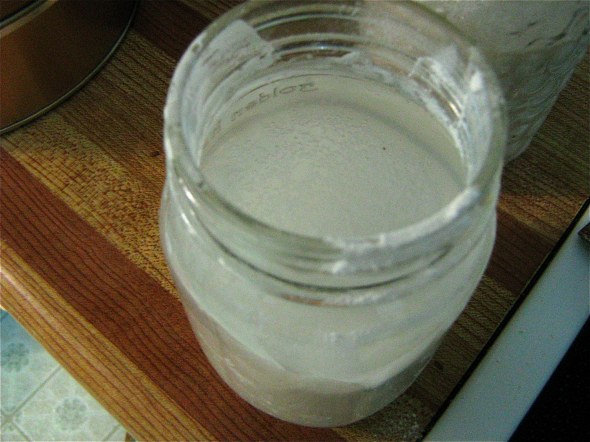
7 sourdough cultures. How ridiculous is that? My 3 gluten-free flour blend cultures are doing wonderfully! They overflow nightly (a good sign I think), but my all-sweet rice flour cultures are struggling. Fortunately survival of the fittest is not in play. My rice babies can keep on trying, well, until Newfoundland runs out of rice flour, that is. One of these nights they'll froth, I'm sure. One is even starting to froth in the picture above. In fact I'm pretty sure that between the 5 bags of the stuff my mom bought after waiting for the Asian convenience store (yes, there is only one) to get an order in and the three I brought home from Montreal we own the most sweet rice flour of anyone in the province. I dare you to prove otherwise.

So grow, my rice babies! Grow!

Friday, December 24, 2010

Grow, Rice Babies! Grow! (Part 1): Adventures in Gluten-Free Sourdough

I currently have 7 sourdough cultures started in my kitchen. Yes, 7 (you just can't see the 7th in the picture...). The basic recipe for sourdough culture is 1 cup of warm water and 1 cup of flour left for 24 hours uncovered in a warm place in a jar. Every 24 hours you throw out half of the culture and add another half cup of flour and half cup of water. So you end up with the same quantity. It's basically like cutting off the lower half of your body every day and letting it grow back healthier.

But instead of throwing out the first half of the culture I've been keeping them and multiplying my sourdough babies. I hope that's okay. I've been cutting off the legs and letting them grow into a new sourdough culture. 1 becomes 2. But then the next night, 2 became 4 when I did the same thing with both new sourdoughs. Fortunately my jars were big and at my next feeding time I managed to only end up with 7 by combining 1. I never was great at math like my brother. I mean, I wasn't bad, but it's all relative. Again, I hope that the combining is okay and I don't kill anyone.

There's a method to my madness, though. I started the culture with rice flour so that my mom could eat it, and because generally in my family's digestive tracts wheat is the enemy. Picture little rice soldiers on horseback wreaking havoc on my family's intestines. Us Eastern Europeans...So I was going to make it a completely rice flour-based culture, but then I figured since I was going to split it in half I should hedge my bets, so the first time I split the culture in half I added rice flour and water to one jar and a gluten-free flour blend of white rice flour, brown rice flour, sorghum gum, xanthum gum and tapioca starch and water to the other.
 The next day the rice flour seemed just as stagnant but the gluten-free blend actually overflowed!!! It was supposed to take days and days to froth if it ever did at all. It happened so fast I didn't really believe it was ready, so I split it again and fed it again. Now I had four rice flour babies and three gluten-free blend babies. Apparently I'm a bit of a sourdough slut...

Tomorrow, bread!

Thursday, December 23, 2010

Coming Home

"There's about a 50/50 chance we'll be able to land in St. John's due to fog," announced the pilot. So when the runway lights appeared out of nowhere and we felt the impact of the landing, was I happy to be home or just to not be spending the rest of the night on the plane wondering when we could take-off again from Goose Bay?

GOOSE BAY! That's in Labrador. At least an hour away.

There are many reasons that flights I've been on have been unable to land in Newfoundland, including:

1. Fog
2. Snow
3: Ice
4. Some combination of #2 and #3 (sleet, hail)
5. Moose

Yes, moose. I've been redirected to Gander because of moose. Then had to take a 4 hour bus ride home to St. John's. It's my personal belief that if you live in Gander you kind of deserve that 4 hour bus ride from St. John's to Gander to think about why you live in such a hole. Sorry to anyone from Gander. There are worse places to live in this province, I suppose.

The point is that I was watching "Eat, Pray, Love" on the flight and didn't make it to the end because we actually landed. It was a bit of a relief since the part on gelato (highly glossed-over anyway) was already over, and it was all downhill from there...

My other point is that when the captain made the announcement, most people sighed and moaned a little. All you can do at that point is pray, which is why I'm glad I was watching the movie. I remembered how lovely the book was. There's a very sweet line where the main character is in an ashram in India talking to another resident. He says:
"Think of what you could do if you took all that effort and space in your head you use to think about him for something else. Think about him fondly, wish him well, then take a big breath and let God rush in to the space. Let his spirit fill you up, feed you with cold, brilliant air."
So as a prayer to land in Newfoundland, I took a deep breath and pushed out Montreal, and in came this big swell of home. The lights from the airport appeared outside the window, and as the plane wheels set down the world seemed to sparkle.

Wednesday, December 22, 2010

Slow-Cooker Chicken Barley Risotto with Thyme

Another lunch date with my aunt pushed me to make some soul food. That means something creamy that fills you up from the inside out. Basically that means risotto. Risotto is one of those things I rarely have because I don't usually order it at restaurants and I rarely make it at home. At restaurants it's either started with butter or pre-finished with cheese, and if I'm at a place where neither of these is the case that usually means the restaurant is good enough that there's something else interesting on the menu to try AND I'm getting ripped off since risotto's generally dirt cheap to make since usually the only thing in it that costs anything at all is the cheese, which I'm not eating. Sometimes there's truffle oil or lobster involved, but not enough to make the dish worthwhile. I mean, I've had good risotto before. The other problem is that it rarely fills me up. I can eat way too much of it, so I'm rarely satisfied. At home, it usually requires a ton of stirring and I prefer to use a home-made broth (the other problem with sub-par restaurant risottos), so there's a fair bit of effort that goes into my not ending up full.

But I made it. Mostly because I have a slow-cooker and barley risotto works great in a slow-cooker, so take the effort out and it's almost worthwhile. With risotto the trick is to keep the rice grains al dente -  chewy without being mushy and over-cooked. The slow-cooker is an al dente genius. There's a 1 1/2 hour window of time where those barley grains are lovely.

All you do is sauté a bunch of onions or leeks (and garlic if you wish, and I do) in some olive oil (or butter if you wish, and I don't; butter is more Northern Italian, olive oil more southern, and lactose-intolerance doesn't care about my love of Milan). Make sure the onions soften thoroughly, because if they don't you'll end up chewing them, which makes the risotto very un-appetizing. Now you can add firmer vegetables such as carrots if you wish. Sauté 5 more minutes. Then add 2 cups of rinsed pearl barley, a teaspoon of salt and 1/2 teaspoon of black pepper (though I would use Sezchuan peppercorns for special occasions, just for fun). Stir for one minute on medium heat then add 3 cups of broth, a few sprigs of fresh thyme or a bunch of dried (but fresh is a million times better for infusing the broth) and one 28 oz can of tomatoes with its juice (I used my home-canned organic farmer's market tomatoes and their juice...the dish tasted like summer...mmm...). Coarsely chop the tomatoes beforehand if they're not already diced. You can also break them up in the skillet if you don't care about it being all perfectly chopped and beautiful.

Put the whole thing in a slowcooker for 8 hours on low or 4 hours on high and voila! Heaven.

About 10 minutes before serving add some kind of protein if you wish. I had leftover roasted chicken which was perfect. Nordic shrimp or maybe crab or lobster (though they make this much more labour-intensive) would also work. Red meat you could get away with, but in that case they should be served separately: Risotto alone should be a first course (primo, in Italian) and the meat should be the second (secondo). Tradition and all.

Speaking of (massacring) tradition, the great thing about this recipe is you're not stirring it for 25 minutes and adding more and more broth slowly, a half cup at a time. You also don't end up with an over-salted risotto from adding more and more stock that boils off but leaves behind its sodium content. And if it burns it's the fault of your slow-cooker for not having a proper "keep warm" setting. If you get to it 30 minutes later than planned everything should be just fine. Coming home to cooking risotto also makes you feel like the smartest person alive. Give yourself a pat on the back before digging in.

If this is too bland for you, boil some balsamic vinegar down in a small saucepan until it reduces by half. Mmm...balsamic reduction. Why would I ever buy this at a restaurant when it's so easy?

Caramel Apple Tarte Tatin and Not Burning Things

Home-made Tarte Tatin
Tarte Tatin is a butter-heavy, caramel-coated, sugar-drenched delicacy. Basically I thought my dad would love it and it would challenge me to make better pastry. I'd seen recipes that called for a simple pie crust for the dough and how could that possibly end up layered and flaky? 
tarte tatin
So, yeah, it burned a little because I suck at multitasking. The recipe also called for too few apples and they kind of fell apart in the sauce, and I used some agave nectar, which I think burned faster.All in all, though, great success because I made the pastry using a mx of gluten-free flour and spelt (yes, I know spelt is not gluten-free, but I needed more flour and my options were wheat and less wheat - aka spelt).

The tart is traditionally cooked in an oven-safe skillet (cast-iron or stainless-steel) so that the caramel cooks on the stove and coats the apples before being covered in puff pastry and baked to a golden brown in the oven. You can also transfer the contents of the skillet to a 9-inch round baking dish for the final step, and you can use frozen puff pastry if you prefer not to make your own, but the home-made, slightly time-consuming pastry will be so much better.

Tarte Tatin
Oh, and even though I over-cooked my caramel a little, it was still delicious...

Crust
3/4 cup cold butter, divided (or Earth Balance. Add a pinch of salt if you use unsalted butter)
1 tablespoon sugar
1 1/2 cup cake and pastry flour, or all-purpose (you can also use a gluten-free flour blend, but it won't be as light and flaky as the cake flour or even the all-purpose. It will still be delicious, and I haven't found gluten-free puff pastry yet)
5-6 tablespoons ice water

Filling
5 medium apples (Gala, Golden Delicious, or other firm baking apples)
½ cup butter (or earth balance)
1 cup sugar (you can also use agave nectar, or a mix of agave and sugar, but it will cook faster and burn more easily)
Tarte Tatin
Crust:
The trick to puff pastry is to keep everything ice-cold says Irma: your hands, the bowl, and the rolling pin. If using frozen puff pastry, thaw a piece and roll it out to a circle larger than the diameter of your oven-proof skillet or baking dish. Place the dough on a baking sheet, cover with plastic wrap, and refrigerate until needed.

1. Sift the flour. Wash the cold butter under cold running water (skip this is you use earth balance. It should become soft but stay ice cold. Massage it in your hand until it's creamy and waxy. Knead it briefly with cold hands until no water flies off it. Place a quarter of the butter in a cold bowl and shape the rest into a flat square and place in the refrigerator (with earth balance just measure the butter and add 2 1/2 tablespoons to the bowl and put the rest in the fridge).
2. Add the flour, sugar, and salt to the butter in the bowl. Cut in using two knives or your fingers until the pastry looks like small peas. Add 5 tbsp of the ice water and combine. Add the remaining 1 tbsp water if the pastry is dry or a pinch of flour if it sticks to the bowl.
3. Refrigerate 15 minutes and start chopping the apples (see below). Roll the pastry out to a square shape on a clean, floured counter, rolling out from the centre only, not back and forth. Put the refrigerated butter in the centre of the dough and fold the four corners to the centre to cover. Refrigerate 10 minutes and start making the caramel (see below).
4. Roll out the dough again into a square and fold the corners to the centre as before. Chill again. You can repeat this process up to 4 times if you have the time, but if not, work quickly and fold 3 more times immediately. Roll the pastry out to a circle slightly larger than the diameter of your oven-proof skillet or baking dish. Place on a baking sheet, cover with plastic wrap, and refrigerate until needed.
5. Remind yourself that home-made pastry is better than frozen and this will all be worthwhile.

Caramel Apple Filling:
6. Peel, core, and quarter the apples. Cut the tips off the apples so that they will fit more snuggly against the side of the skillet. The apples will discolour a little but it doesn't matter. You can sprinkle them with lemon juice if you really want to.
Tarte Tatin butter and sugar7. Melt the butter over low heat in a large skillet. Remove from heat, add the sugar, and stir until blended. Arrange the apples on their sides in the pan so that the front of each piece touches the back of the next. Continue the fan pattern, starting from the outside of the skillet and working your way in. Fill in the gaps with the removed apple tips. If you are transferring the apples later to a baking dish, it's not necessary to do this beautifully.
Tarte Tatin8. Return your pan to the stovetop on high heat. Boil 10 to 12 minutes, or until the pan juices are lightly golden but not dark or burnt.
9. Preheat oven to 375° F.
10. Remove the skillet from heat. Being careful not to burn yourself, turn the apple slices over with the tip of a sharp knife, keeping them in their original places.
11. Cook 5 more minutes, then remove from heat. If not baking directly in the skillet, transfer the apple slices to the buttered baking dish. (Now you may want to be artistic with the fan shape of the slices.)
Tarte Tatin12. Place the pastry on top of the apples and brush off excess flour. Fold the edges toward the centre of the skillet or baking dish. The folds don't have to be pretty. Bake in oven until the top of the crust is golden-brown in color, about 25-35 minutes. Remove and let cool 25 minutes.
Tarte Tatin
13. Place a plate or other serving dish on top of the pan and quickly flip tart over onto the plate. Check to make sure the apples aren't sticking to the bottom of the dish before removing it completely. Slice and serve with ice cream, and pat yourself on the back. Tarte Tatin