Showing posts with label Indian. Show all posts

Thursday, December 2, 2010

Roti Chanai, Take 2, with Roasted Squash and Jalapeno Pickle

I'm all about eating locally, and Indian food is not exactly what immediately pops to mind. I'll tell you, though, everything in this dish was local, from the chili peppers to the squash, to the flour for the roti.

Last time my roti turned out pretty ugly, but delicious. This time they actually crushed properly. Well, it's not exactly supposed to be crushed up like this, but you are supposed to kind of smash it up a little so it's flaky...I just went a little overboard and got rid of the evidence that I didn't make it very well. Then I used the pieces to scoop out the sweet pumpkin flesh of the my roasted fellow and ate it with my Indian jalapeno pickle. Side dish of champions. I had to ration myself to only half the squash.

Saturday, November 27, 2010

Inexpensive Moong Dal and the Montreal Metro's Helpful Spice-Grinding Tips

So I was in the metro yesterday and looked up at the big MetroVision screens that tell you when the next train is coming and give you some generally uninformative news headlines, when lo and behold, I read the following:
"To grind spices in a mortar and pestle, crush them using an up and down motion."
Now that's loosely paraphrasing from the French but the "up and down motion" was pretty word for word ("d'haut en bas" I think?). Well, thanks MetroVision. And here I thought you never did much of use besides pass the time, but no, here you are informing the Quebec populace to grind whole spices themselves and exactly how to do it. Well, not EXACTLY...

There is actually mortar and pestle technique, and many Quebecers will be frustrated that their spices jump all over the place because their mortar is too small, or too light, or not coarse-edged enough. My mortar and pestle technique was first learned in Poh's Kitchen. The "best mortar and pestle" discussion gets going about 2'45" minutes into the episode, and the "technique" discussion is at 5'40":


What I basically learned from this episode is that if I ever want to marry into an Indonesian, Thai, or Malaysian family I'm going to have to work on my spice-grinding technique (Note how I did not write "grinding" technique. That would have been embarrassing). I need to relax my wrist and let the weight of the pestle do more of the work.

What else I learned from this episode was that fully smashed chilies are very hot, but bruised chilies are more subtle. Final important Thai cooking tip: heat fades in oil, so the ton of oil in the cooking makes the heat more manageable. I'll take the heat and cut the oil to the minimum, thanks.

Now if only these things would stick in my head, since I watched this episode in the early summer and I am still nowhere closer to marriage. Not that I was trying or anything. God...

The point of all this is that:

1) The Metro is good, but not great since it didn't tell Montrealers to toast their spices before grinding, but it did tell them to not buy pre-ground spices.

2) If I can't marry a Thai, maybe India will take me, since I've put my mortar and pestle skills to work a few times lately in Indian dahls (or dals).

"Dry" Moong Dal
Sookhi Moong Dal

I actually had moong dal in my cupboard! I bought it randomly, figuring I'd need it sometime for an Indian recipe. It actually worked. When does that ever work? You can find it at Indian/Pakistani/Bangladeshi grocers, so anywhere in Parc Ex or Pointe Ste-Charles (though it may not be labeled and you may need to have a hand conversation. Fortunately "moong dal" is still "moong dal" internationally. Just don't spell it for the person in the shop. That would be silly since the package may or may not be labeled in English. Well, maybe not silly. Do what you must and try not to feel like an embarrassed, culturally curious but under-educated Canadian. We all are, but just don't admit it. It's like academics never saying their sorry. For the love of God, why don't people apologize more. I don't mean walk around apologizing for every silly little thing, but if you can say excuse me when you bump into someone or "pardon", a better version in French, then surely people can admit they're wrong without admitting weakness. I digress...

1 cup (200g) moong dal (you can't really substitute other dals without changing the cooking time)
4 cups plus 1 tbsp plus 1 cup water
1 tsp coriander, ground
1 tsp cumin, ground
1/4 tsp ground turmeric (if you can find whole, by all means grind it)
1/8th-1/4 tsp. cayenne (I obviously tend toward the 1/4 tsp, but I understand that others may disagree)
2 tbsp oil (not olive. I used oil drained from my Indian jalapeno pickle...for extra heat, salt, and flavour)
1/2 tsp. salt (I used less because there was tons of salt in my pickled jalapenos already...actually, I think this time I forgot again and cursed myself for having made the same mistake twice - adding too much salt, as I did in my pickle in the first place)

For the Baghaar (the hot oil, spice mixture that seasons the dish just before serving):
1 tbsp ghee or oil (ghee is good for flavour, but you can't use butter even though ghee is just a clarified butter. You COULD use 1 tbsp butter and 1 tbsp oil so the butter doesn't burn, but an Indian person will not be impressed. You will not find yourself anytime soon. That is obviously your goal, I know...I just used 1 tbsp more of the chili oil from my Indian jalapenos pickle. More heat, more flavour, more salt...)
1/2 tsp cumin seeds
1 dried, red hot chili (optional, especially if you use a chili oil like I did)

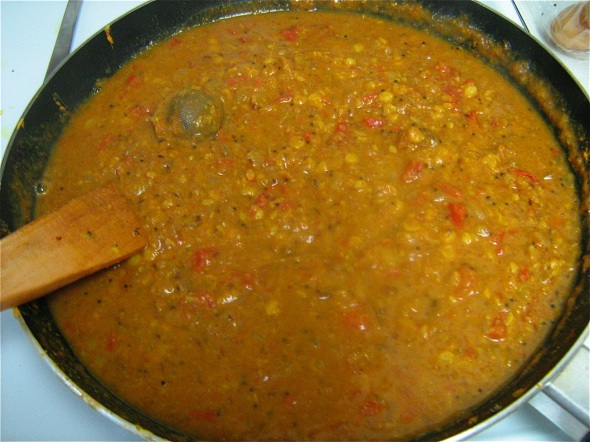
All you do in a dal is cook the lentils and then season is with a baghaar (the spice mixture cooked briefly in oil) which gets poured over top. It's the simplest dish. This one adds an extra step of seasoning with more spices in advance, and you'll find the dish much easier to digest if you follow the lentil soaking procedure. It basically acts similarly to "raw" food dishes where you want to release enzymes that give your stomach more of a work-out than it needs.

Wash the dal is several changes of water. At first it may not seem that any cloudiness is coming out, but stir it gently with your fingers for a minute to get it to open up to you, like perfect basmati rice, but longer. Drain the rice, then pour 4 cups of water (or more. You don't really need to measure. It's not a big deal) over it in a large bowl and let it sit for 2 hours. Then drain it again. Let it sit in the colander to wait, or don't use quite as much water later after you add the dal to the pot. It should end up being not too dry, but definitely not mushy from over-cooking to evaporate excess water.

Now the recipe says to use pre-ground spices but that's ridiculous. Do it only if you are satisfied with mediocre flavour. Sometimes I too am satisfied with it, but where you're cooking with water, not broth, the dish needs all the help it can get. So I toasted the coriander and cumin instead in a frying pan over medium heat for just a few minutes until they had browned slightly, giving the pan a good shake from time to time, and then ground he spices in my too-small mortar and pestle using my pre-discussed poor technique and tight wrist. Coriander flew everywhere, those little buggers, but eventually I was happy with the texture of the grind. Not too coarse or you'll be biting into coriander seeds (not really fun...or easy to digest) but not too fine. You can also grind in a blender or food processor or coffee grinder, but these are very fine grinds. In this case it's okay, really since the original recipe calls for pre-ground spices)

Phew! Done. Now combine the ground coriander and cumin with the turmeric, cayenne and 1 tbsp water in a small bowl. Stir.

Put the first amount of oil (up to 2 tbsp. I usually skimp a little, but not much or the spices will burn. A good trick is the keep all the oil to one side of the pot and when add add the spices directly onto that area instead of letting the oil spread all over the pot and not be a thick enough layer to keep the spices from burning) in the pot and when hot add the spices and water from the bowl. Do this with a rubber spatula so you get everything out all at once.

Give the spices one quick stir in the corner of the pot with the oil and then add the drained dal. Stir to mix. Add the salt and 1 cup of water. Bring it to a boil and then cover the pot tightly (place a plate on top if you can/have to to keep the lid tight) and turn the heat to "very low" for 15 minutes. This is a bit tricky because every stove is different and you don't know the first time you make this what the perfect heat will be. You want the dal grains to be tender and most of the water to be absorbed. So after 15 minutes (no peeking beforehand) test some of the grains to see if they're tender. If there's an obvious layer of liquid still in the pot and the grains are tender, then turn up the heat, remove the cover and let it boil off a little. If there's too much water and the grains aren't tender, bring the pot to a boil again, put the cover back on, and reduce the heat to slightly less low than last time. Let cook 5 minutes and check. If still not tender, cook 5 more minutes, etc.

Take the cooked dal off the heat and leave covered, waiting to be spiced. Or place the cooked dal in a large serving bowl and do the next step fairly quickly. It won't cool down that fast, but my kitchen is frigid...

For the Bhagaan:


Put the ghee (or more oil) in a small frying pan and when it's hot put in the cumin seeds. 3 seconds later (love it) add the red chili if using and cook 3 more seconds (amazing). It's supposed to darken and puff up a little but well...don't cry if it doesn't. You're probably already not getting married at this point. So it's been a total of 6 seconds and now you can pour the whole contents of the frying pan over the hot dal. You can stir, or just leave the spices on top as a kind of garnish. Fried onions are a traditional garnish, and delicious, but a lighter option would be chopped coriander...or more pickled jalapenos...mmm...

Sunday, November 7, 2010

Extraordinary Eggplant: Indian Bringal


I've gotten into the habit of roasting or even boiling (in a rush) eggplant and then seasoning it with a blend of "hot", "salty", and "sweet" (ex: cayenne + soy sauce + oyster sauce; chili paste + fish sauce + hoisin; red pepper flakes + miso + mirin, or some combination of these which become mostly Chinese, Vietnamese or Japanese dishes), but sometimes a recipe comes from a reputable source and I just have to try it (this is officially an Indian or Bangladeshi dish, similar to bhartha, but with much more nut flavour and, despite the huge quantity, less oil than you'll find in restaurants). There's no added sweetener but the eggplants should be sweet enough on their own, even without taking out their seeds or leeching out their liquid with salt first (eggplant cubes in a colander for 30 minutes is standard, but the extra salt plus the wait time is annoying, says the girl who just spent 5 days making ginger confit...).

This was the best eggplant dish I've ever made, and I've made a lot of eggplant. It's no good the second or third day. It has to be fresh because the sesame flavour dies and then whole thing is kaput. But do it perfectly, and life is beautiful...


Ingredients
4 medium Asian eggplants (1 1/2 pounds - the long, thinner, lighter purple ones)
1/4 cup
1 large onion
1 tsp garlic, minced
1/2 tsp cayenne
1/2 tsp turmeric
1/2 tsp cumin seeds, crushed or coarsely ground (I toasted them first. The recipe doesn't say to do that, but it's standard. It actually made me doubt the recipe that this wasn't required, but no, it was trustworthy. If a person had told me this recipe instead of seeing it printed, though, I would have worn a very quizzical, doubtful face)
2 tsp minced green cayenne chilies, optional
2 tsp shallots, minced, definitely not optional
1/4 cup fresh cilantro

Preheat the oven to 450 Fahrenheit. It's better to char the eggplant over a grill for a smoky flavour, but the sesame oil does a pretty good job adding savouriness on its own, so roasting is fine. If you have a grill in which you can put wood chips to give food a smoky flavour, please invite me over and I will make this recipe for you. We should be friends. I also feel that if you're reading this and we're not already friends we should be friends, with or without eggplant.

Rub the eggplants with a little of the oil and prick them all over with a fork. Roast them in the preheated oven on a baking sheet for 45 minutes. Really you don't even need the baking sheet, you can just put them straight on the bars, but my oven bars don't get cleaned that often and I roast a lot of things that set off the fire alarm and leave some char in my oven, so I went with the baking sheet. Know thyself...

Let the eggplants cool (turn off oven).

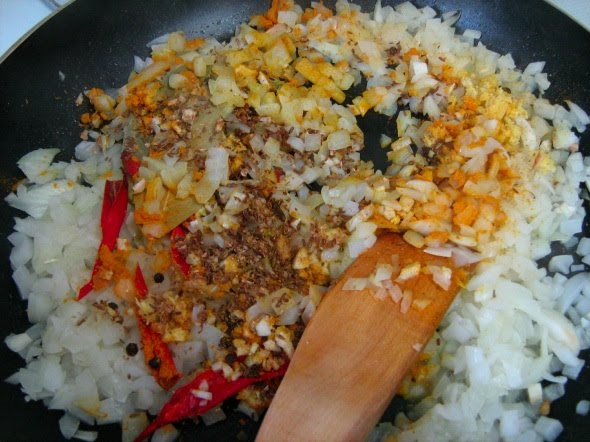
Heat the rest of the sesame oil over medium-high heat in a skillet. When hot, add the onion, garlic, cayenne, turmeric and cumin. This is the giveaway on how this is not an authentic Indian recipe. In a real Indian recipe you would probably never add all these things at once. The ground spices especially would probably go in after the onion and garlic had browned, but it worked fine, and there's enough oil to make sure nothing burns, so really it's fine...

Lower the heat to medium and cook for 10 minutes. Do not have a seat and/or a smoke, walk the dog, start a book, etc in this cooking period. Sure, there's lots of oil to make sure the onions don't burn but you have 10 minutes to cut the eggplant in half, scoop out the flesh, and mash it in a bowl with a fork before the dish is ruined. Starting...now!

After the 10 minutes (set the timer, please) add the fresh cayenne chilies to the onion mixture and stir-fry 1 minute. I think I either used red cayennes or none at all. I certainly didn't use greens. You can also skip this if your tongue doesn't like fire. Mine does. There's a reason there are 4 sets of spicy things in my fridge right now: a jar of Sichuan peppercorn pickled chilies, one fermented Sriracha chili paste, one un-fermented chili sauce, and 4 jars of Indian pickled jalapenos. I maybe don't have a great reason for this, but addictions must be fed, and really, in the grand scheme of addictions I figure I'm not doing so badly. I could be my brother...(I really don't think he reads this. Too busy being a successful addict. If he does read this, we'll talk about it when you come visit me. Bring a grill, some wood chips, and some eggplants and we'll make a time of it. What you don't know, other readers, is my brother visits me once every never, so I have nothing to worry about).

We were cooking, weren't we?

Add the eggplant and salt and cook 2-3 more minutes.

When you're ready to serve (ideally right after the 2-3 minutes is up since the dish isn't getting any more delicious by making it wait) add the minced shallots and stir-fry for 1 more minute. The quick fry keeps you from having raw onion breath for the rest of the night, but also keeps them crisp enough that it really is a garnish. Then garnish each serving individually with coriander (roll it up into a tight cigar and slice at 1/2 cm intervals, approximately). You can garnish the whole skillet with the cilantro but then the plate presentation isn't as beautiful. Normally I would say garnish the skillet and eat from the skillet because it's eggplant, but that's a whole lot of sesame oil and I will have no part in encouraging you to over-indulge in something like 36 grams of fat. It's meant to be one dish in a meal of many dishes. Go find yourself some naan or roti...or puri...mmm... (or other bread) and some protein, and some friends to share it with (only because the dish doesn't keep well. Friends are returnable). Oh, and thick yogurt to cool your burning mouth. You don't want it so hot in there that you can't taste the sweetness and nutty sesame flavour, so periodically dousing the flames in your mouth with cooling tangy yogurt is key. I dare you to tell me this is not an amazing dish.

Tuesday, October 5, 2010

South Indian Sambar: Tamarind, Lentils and Spices

I love making recipes when I don't need to go buy any ingredients. It's only kind of fair because I happen to have a lot of weird ingredients that normal people don't usually stock in their kitchens (chana dal, asafoetida, curry leaves, and even soaked and sieved tamarind in my freezer), but this recipe is exactly why I love Indian cooking - you take a ton of spices, cook them according to a formula and end up enjoying food you were maybe a bit skeptical about trying in the first place. Oh, and your kitchen smells amazing.

Ingredients:
Sambar Powder:
1 tbsp coriander seeds
1 tsp chana dal (like split yellow peas, but not exactly the same. Any split pea substitution is fine, but it won't be exactly the same)
1/2 tsp urad dal (look in South Asian stores and have some good conversations like I did)
1 tsp cumin seeds
1/2 tsp asafetida, grated (this stuff smells like onion...sort of...it's sticky and gets all over your hands, but it's so good for digestion and is everywhere in South Indian cooking)
2-4 dried red chillis
1/4 tsp black pepper
1/4 tsp mustard seeds
1/4 tsp fenugreek seeds (called 'methi', these are little yellow pebbles)
Sambar:
1 cup toor dal. Okay, this is the one place I cheated. I just gone on two major trips in search of urad dal and chana dal and not looked for toor dal. Apparently nothing can replace toor dal in sambar, says the internet, but screw the internet. I used chana dal...it was nutty and delicious and nothing like other sambars I've had, but I'm okay with that. The next time I stumble upon toor dal I'll buy it.

1 lime-sized chunk of tamarind
2 medium onions, chopped
2 medium tomatoes, chopped
1 curry leaf sprig. Yeah trying finding fresh ones...that's maybe a losing battle in Montreal, but dried can be found fairly easily. Cross your fingers and hope they're fresh. Me, I just had a bunch of sort of crushed old ones so I stuck them in a tea infuser (you don't want to eat these guys) and tossed them into the sambar.

1 tbsp chopped coriander leaves
1 tsp salt 
3-4 cups water

Seasoning:
1 tsp oil, 1 tsp ghee (or two tsp oil)
1 tsp mustard seeds  
1 tsp cumin seeds
1 pinch asafoetida (grated and then pinched, presumably)
1/4 tsp turmeric powder

Instructions:
Put the sambar powder ingredients in a small frying pan on medium-low heat. When you can smell them and they start to darken a little, take them off the heat and grind them to a fine powder in a mortar and pestle, blender or food processor. All these spices should be whole, but if you have, say, ground cumin instead of whole, and you're stubborn about not buying the whole ones you can add the ground ones after you've toasted the whole ones before you crush everything together. The ground spices will burn if you add them to an oil-free frying pan with the others. Oh, and it's maybe a bit strange that you wouldn't cook the chana dal for the sambar powder, but that's pretty normal for rice and lentils in South Indian dishes)
Soak the tamarind in warm water (very warm, but not boiling) for 15 minutes. Then take a fine-mesh sieve placed over a bowl and press the soaked tamarind lump through as much as you can. It's a real pain, it's true, but you want to get as much of the softened pulp through the mesh as possible. Throw out the hard material that's left, then add enough water to the pulp to give you 1 cup. 
"Cook the toor dal in 2 cups of water until it's soft". I hate ambiguous instructions like that, especially with lentils that get mushy if over-cooked and chewy if under-cooked, AND every lentil is different, so mine took about 25 minutes, but if I'd actually used toor dal, who knows how long it would have taken. Probably I could have looked it up really easily...I'm up there with people who are too stubborn to buy whole spices, apparently. I'm such a hypocrite. Anyway, bring the water to a boil (after rinsing the dal in cold water a few times to remove any dirt or stones) and add the dal. Bring to a boil, reduce heat to medium or medium-low and simmer for who knows how long...

In a large pot, heat the oil (and ghee). My favourite part: add the mustard and cumin seeds. It'll take them about 30 seconds to start to pop. When they stop, add the asafetida and turmeric powder, curry leaves, and chopped onions. Cook 5 minutes. Add tomatoes. Cook 5 minutes. Add 1 cup water. Add ground sambar powder. Boil. Inhale. Smile. Exhale.
 Mash the cooked toor dal (with a masher, a large, blunt object, or in a food processor. A blender will suck. It probably won't blend well unless you use something intense like a VitaMix. Add the dal to the spiced tomato mixture in the large pot.
 Boil for another 5 minutes. Add the tamarind pulp and salt. Stir and add more water if needed (it should be more like a soup than a stew, but the flavour gets watered down pretty quickly, so be careful, especially if you didn't work that hard at pushing the tamarind through the sieve). Boil for yet another 5 minutes.
Turn off the heat, cover, and prepare dosa or idli, or get the rice that you started cooking 25 minutes ago (you did, right? I sure didn't...). When you're ready to serve, top the sambar with chopped coriander leaves. Normally every person at the meal would get a small bowl of sambar so you can garnish each individually, or give up from exhaustion and just throw all the coriander in to the hot soup to lose its colour and some of its flavour and nutritional clout  : )

This is perfect to make with dosa because they take no time at all. Rice can be made in advance, but idli seem as though they may be a nuisance. I'll try that sometime and let you know.

Sunday, October 3, 2010

Mysore Masala Dosa

This was the first time I ever "winged it" with an Indian recipe. I mean, it's not as though I threw the recipe out the window, but there was nothing that said "30 seconds later add the" or "2 minutes later combine the", as Madhur Jaffrey is prone to do in my favourite Indian cookbook. Actually the cookbook of hers that I have doesn't have many South Indian dishes. So I turned to the internet with its sketchy, and often missing, instructions for a recipe for mysore masala dosa - my favourite fermented rice and lentil crepe known for its slightly (to not-so-slightly) spicy potato filling.

Ingredients
3 cups boiled and slightly mashed potatoes
2 cups chopped onions
1/2 cup boiled peas (not really optional, but I didn't have any, so for me it was optional. For you, well, you can do what you want)
3-4 finely chopped green chilies (I only had red. Well, oops, but that's what I'd bought in bulk at the farmers' market, so that's what I used)
1/4 inch piece of ginger, finely minced
2 cloves of garlic, crushed or minced
3 tbsp oil
1 tsp mustard seeds
1 pinch asafoetida
4-5 curry leaves
salt to taste
1 tsp turmeric 
1 tsp cumin 
chopped coriander
1/2 cup grated fresh coconut (again, not really optional, but the fresh coconut options around the city are minimal, and I'm just one person anyway, and that's a lot of coconut to eat. So I kept my carbon footprint relatively in check...or at least let it balance with my purchase of Greek figs. So worth it).

See, there were no actual instructions on how all these things should be put together, but with some other dosa cross referencing, I got the general idea. Besides, you'd rarely see an Indian cook with a recipe...but that Indian cook would probably have grown up in a household where such things as recipes were passed down from mouth-to-mouth, so to speak.

Directions:
Boil the potatoes. Boil them whole if you've got the time, since they slip easily out of their jackets and I think retain more of their nutrients if boiled with the skins on. If you don't have time, peel them and chop them into smaller sections. When a fork goes into them easily, remove them from the pot and either plunge into ice water to cool, or let them cool on their own while you're busy doing other things...

...such as chopping the chilies. I like to take the seeds out before I chop the chilies, since the seeds give pure heat and no flavour, but if you want that burning sensation to come quicker and don't care about the heat, leave them in and save yourself the trouble. Get all the other ingredients ready and measured. This goes pretty fast, so unless you are a chopping superstar whose spices are all alphabetically organized, be humble and do the mise-en-place. Oh! That includes peeling and mashing the potatoes. You CAN mash them after you've thrown them into the frying pan later, but it takes extra time and thing may burn while you're attempting to mash. Then if you're like me you know they're not going to want to mash and you'll start swearing at it and cursing your lack of a decent potato masher, when a slotted spoon would have been just fine if you'd actually mashed the potatoes before you'd turned on the heat...but that's just me. You are much smarter than that. Anyway, mashing roughly is fine. I kind of like the lumps because potato purée dosa has a less interesting, more baby-food-like texture.

Okay, go! The oil goes in the large frying pan on medium-high heat. When it's hot, add the mustard seeds and asafoetida. Wait 30 seconds. With mustard seeds you always wait 30 seconds, well approximately. You wait for them to "pop" and in every recipe that apparently takes 30 seconds. Mine didn't pop...so I cried a little inside and turned up the heat. Maybe my pan wasn't ready yet. 
Then add the ginger, garlic, chilies, and curry leaves and stir relatively frantically so it doesn't burn. 
When everything is getting a little softened and brown a few minutes alter add the turmeric, cumin and coriander. Now you really need to stir since the dry spices will burn very easily. When it's stirred (it doesn't need to cook more than a minute) add the potatoes (pre-mashed!) and stir everything. The potatoes should turn yellow-orange from the turmeric. The oil will get sucked up, as though through a straw, into the potatoes and your masala is done. You can add a little water to thin it and make the potatoes a little more tender if they're a variety that's naturally starchy. Oh! Salt to taste! Very important! There's no other salt in this recipe and the salt really brings it together, so be generous. Garnish with chopped coriander (cilantro) and wrap in dosa. Die from joy from eating so luxuriously, simply, and healthy. Okay, maybe don't die, but experience some kind of blissful state. Please.

Friday, October 1, 2010

South Indian Dosa

The South Indian Crepe. It looks a bit like a doily, I know. After about 4 days of mostly eating dosa I think I got okay at the technique.

My first try looked like this:
Not bad, but not the beautiful lattice work that I like. I experimented with making it thinner, sometimes ending up with gaping holes that needed to be filled in:
but it was crisp and chewy. It's supposed to be bendy, and be able to fold around its fillings but mine never got that way, even 12 or so dosai later. Maybe my heat was too much, or I didn't use enough oil, or the batter was too thick, or too thin...Well, I'll keep trying. Since I'm allowed to eat with both hands (and/or utensils), it didn't really matter that the dosa was so un-bendy.

It's really simple to make. It's just slightly fermented long-grain rice and lentils. Here's what you do:

3 cups long-grain rice (basmati is perfect)
1 cup skinless split urad daal (skinless black gram)
3/4 tsp fenugreek seeds
Salt to taste (a sprinkle or 1/4 tsp.)
Oil of choice

So it's maybe hard to find split urad daal. I went to a place in Pointe Ste-Charles (the equivalent of the Goulds in Newfoundland...kind of) and said I was making dosa and the man gave me a bag of dal. I said, "This is for dosa?" (This was before I actually had looked at a recipe), and he said "yes." Don't trust a man when it comes to Indian food.

It was chana dal, which was fine, because I can make daal (the soup. The spellings of all these things are a bit ambiguous) out of that, and I used it as a tuvar dal replacement in the sambhar (recipe to come). Different flavour, but I like the nuttiness. Anyway, so then I went to Parc Extension and asked a female store clerk where the split urad dal was. "Skinless or not?" she asked. "Skinless, " I said. She pointed me to an unmarked bag around the corner. What's up with not labeling bags? She lined up her hands vertically as she shook her head. Oh! The one next to it! Another unmarked bag that was just a tiny bit lighter but otherwise identical. Yes, that one, she nodded.

"Why do you know about urad dal?". Not "how", but "why", she had asked. I'm assuming she just used the wrong word, but the verbal slip was interesting. It made it seem as though urad dal is something I'm not allowed to know about, as if it's a secret.

"I'm making dosa," I said simply. "I like South Indian cooking". I smiled, thanked her, and left. I like to think that she shared a secret with me.

Directions:
You need to make this the night before or start VERY early in the morning. The nice thing is, you don't need to make it all at once, since it just keeps fermenting on day 2 and 3. I'm not sure how long it's okay to let it keep going, but I felt comfortable using it up to day 4.

Wash the rice and dal in several changes of cold water, swirling the grains around with your fingers like you would for perfect rice.  Drain it and add the fenugreek seeds. Add enough water to cover the rice and dal by about 2 inches. Soak overnight, or about 8 hours.

The next morning, drain all the water again. Put the rice and dal mixture in the blender or food processor, in batches if necessary, and grind to a grainy paste. You can add a little water if you need to.

Put the ground mixture back into the bowl you used to soak it and add enough water to make a batter. Mine was initially pretty thick, so don't be afraid to thin it out. It should coat a spoon thickly, but you're going to spread this very thin, so remember that it's a crepe not a pancake.

Add the salt and then put the batter in a warm, dark spot, covered, for 6-8 hours. I put it in the oven with the door open on lowest heat. I would have normally just put it in with the light on, the oven turned off and the door closed but for the "dark spot" rule.
Now the batter's ready. Stir.

Get about 1/4 cup of oil ready in a bowl with a basting brush at hand, and take a paper towel dipped lightly in oil and spread it over the bottom of a large frying pan. The oil should be barely visible.
Turn the heat to medium and let it warm up. When hot, take a 3/4 full ladle of batter and pour it in the middle of the frying pan. Now sweep the dosa in ever-expanding circular motions with the bottom of the ladle (plastic if the pan is nonstick!) until the dosa is about 8 inches (the size of a small cake pan) in diametre. Tiny holes are normal and just fine. Some kinds of dosa have them and some don't. It's personal taste and what kind of filling you have that determines if this matters.

Once the batter is spread, immediately dip the basting brush liberally in the oil and drizzle it all over the surface of the dosa and also around its edges. Now hold the pan by its handle, lift up and swirl it to make the drizzled oil spread all over the dosa. Careful not to swirl the dosa right off the pan like I did the first (few) time(s).
After a few minutes check the bottom of the dosa. It should be light brown. The first dosa sometimes isn't evenly browned, but don't worry. Years of pancake-making taught me this is fine, and the second batch will be more consistent. Flip the dosa. Cook 1 more minute, or until the bottom is lightly browned. I don't like it soft and chewy, so I made sure it really got enough cooking time, but I think I overdid it because then you're supposed to fold the dosa in half and let it cook 30 seconds more. This is probably an important step I skipped...

You can eat dosa plain, or with coconut chutney. Since I'd have to buy a whole coconut to get a decently sweet-tasting chutney, I skipped it and just went with hot sauce. Very non-traditional. The second dosa was ready at the same time as my potato masala filling (recipe to come), though, so that one got all wrapped up burrito-style...well, cracked burrito-style. Still, delicious burrito-style. The next day I added sambhar. That was when everything in my world got a lot sunnier.

To make the second dosa you need to run a paper towel under some ice cold water and rub it over the pan to remove any dosa debris and cool the surface. Apparently this makes your dosa not break as easily since the pan is cooler. Then proceed as before with a little more oil on a paper towel and 3/4 of a ladle of batter. So easy. 5 ingredients. Go forth.


Saturday, July 3, 2010

Slow-Cooker Lamb Curry with Basmati Rice, Tomato Relish and Grated Cucumber Raita


This is in my top 5 recipes ever and my top 2 lamb recipes. It beats out braised lamb shank in all its forms and sauces, and only comes second to 2-day marinated leg of lamb with dried figs and poppy seeds.

Sometimes you need an excuse to make a recipe, and part 3 in the Midnight Poutine series "Greg Got A Slow-Cooker" had to be written after Greg got back from Scotland and before Greg left town for Maine for the summer. This was a 3 day window of Indian food opportunity. In came the lamb.
Now, you can't just make lamb. You need to make rice to soak up the luscious lamb juices, and then you need a yogurt, preferably with refreshing cucumber to cool down the body. You probably also need some kind of green vegetable or tomato salad. All Greg needed to worry about was the lamb, as it was the highlight of the meal, and the focus of the post.

Since he'd been in Edinburgh, he said I'd love all the "curries" there. That was the inspiration for making a lamb curry. These are not exactly traditional Indian curries, but are completely delicious. To recreate the Edinburgh curry effect for him (but better) I went to Judith Finlayson's Slow-Cooker Cookbook and found a general beef curry, substituted lamb, and knew it would be great. I love this book, and since her recipes in the slow cooker still call for whole spices, it's a lot closer to authentic Indian fare than something out of Bonnie Stern, much as I respect her. Judith Finlayson is no Madhur Jaffrey when it comes to Indian cooking either, mind you, but that wasn't what I was going for this time.

...and Judith lived up to my expectations. I can't describe how incredible this dish was...well, maybe I can. I bought the meat from Atwater market from a butcher who gave me the 2lbs of cubed Quebec lamb meat I wanted (not specifically organic, but I didn't want to know and I didn't ask and I couldn't afford the $40 price tage on the organic place behind me. This came to $25 and the butcher was nice) along with a big bag of bones for free to make broth. THAT is why this recipe was amazing. I made my own lamb broth. It was the best broth I have ever made, and I used the recipe from Bonnie Stern's Heartsmart Cooking. These women...I tell you, they're smart. I will do a separate post on the lamb broth because it deserves it, but not now.
The lamb...there isn't even a lot of salt in this recipe but the result was perfectly salty, the meat was perfectly tender, not falling to pieces, but just chewy enough to release flavour in each bite, and the flavour was rich...the juice was flavoured perfectly with bay leaves, cumin, coriander, chili, cloves, cardamom, black pepper, ginger and garlic, with just a little turmeric for colour.
The cubes got browned in the oil, which had been heated on medium-high and turned up a tiny bit once the meat was added. You don't want to slow-cook these things yet. You just want to sear them. I was worried they may have overcooked since they didn't really brown. I think the heat should have been higher, but it all worked out fine. The meat got moved to the slow cooker, and a little of the fat got drained from the skillet. Then the onions were added.
Judith is very reasonable about the order of adding spices. None of this 37 seconds later, 11 seconds later stuff. I won't say "nonsense" because it has never NOT worked when Jaffrey has told me to do it, but I question it...the slow-cooker recipes are made for people who don't like asting time with things like counting to odd numbers, thank goodness. So everything else got added all at once, except the stock and bay leaves. I did grind the cumin and coriander, though, since the recipe called for ground, not whole. It didn't specify if you should grind your own, but I always do this for freshness and flavour...and because I feel wasteful buying multiple versions of the same spice.These coriander and cumin seeds are not yet ground...

Then the tomatoes, then the broth. Just a half a cup. I was tempted to put in more because I had gone to all that work to just use a half cup of broth, but no, Judith would not lead me astray, and if she had I wouldn't know until later. Trust, Amie. Trust.
Everything got poured on top of the cubed meat in the slow-cooker stonewear, and mixed together. Yes, they call it "stonewear". It doesn't seem very stone-like to me. Just large, heavy and awkward, but perhaps the first slow-cooker ever was chiseled by our ancestors out of large slabs of stone off the side of a mountain somewhere. Who am I to argue with history and tradition? No one, that's who.

I set the slow-cooker to high and had waited patiently for four hours. I prepped the rice, instructed Greg on how to wash the grains (5 times) then leave them to soak. Finally, a half hour before eating time we drained the grains again, added the right amount of water and turned on the heat. We made perfect rice. He fluffed after 25 minutes, then put it back on the low, low heat for another 5. Nothing burned. It would have been a miracle if this had been 6 months ago, but now I am relatively good at making perfect rice. I am channeling my inner rice guru/Indian mother, or I can stop being so dramatic about it and just say I'm retaining knowledge for once...definition of insanity and all, not learning from your mistakes and doing the same thing over and over again expecting different results...well, not this time.
When the rice went on the ground almonds had to be added to the lamb. Then back on HIGH for 30 minutes. It looked so luscious and thick. No cream, no dairy, no coconut. I love it. The pools of grease I expected weren't even that bad, since the cubes had been decently trimmed and I'd skimmed the broth. Still, this was not a low-fat meal, and I could taste it...happily.

Chop, chop, chop tomatoes, grate, grate grate cucumbers, roast, roast, grind cumin. A little salt, a little pepper, a little cayenne, some yogurt and some parsley (wimpy cilantro) for the side dishes, and everything was ready.

There is absolutely nothing in the world like whole spices cooked on low heat for hours in a rich, meat-based sauce. Nothing. Cloves, cardamom, black peppercorns...then the almonds...so sweet and fresh. Do not use a bag of pre-ground almonds from the supermarket. Get them from a bulk place that goes through quantity fairly quickly. Turkish or Middle Eastern places are generally great, and my favourite place is currently in the Atwater market upstairs by Premiere Moisson. There are no words for the joy this meal brought me. I think the sounds I made were, in fact, not words. Just happiness. The description and representation of happiness are not words. So simple, happiness.

Friday, January 15, 2010

Naan, take 2: Madhur Jaffrey's Indian Cooking

I've come a long way since the last time I made naan...about 3 weeks ago.

I have subsequently learned to knead. Since my last naan didn't rise properly, I figured I should go out of my way to figure out this leavened bread business. People have been making it successfully for a long time. I too can be one of these chosen people.

I took the same recipe from Madhur Jaffrey's "Indian Cooking", avoiding the more difficult recipe I heard about in a prominent Vancouver chef's self-titled "Vij's".

This time I didn't overheat the milk, being scared to kill the rising agents in the yeast. The mixture of sugar, yeast and milk got properly frothy in a wide-rimmed bowl. the only change I made to the recipe (intent on not messing up) was adding almond breeze instead of yogurt to the dough mixture of sifted flour, salt and baking powder, sugar, yeast mixture, oil and egg. Oh, I used extra-virgin olive oil instead of vegetable oil because my budget is tight so I only buy one type of oil...obviously olive wins. A splurge on good olive oil is better than a bunch of different flavourless oils anyday. Well it's not entirely true that all I have is olive oil...I do have sesame oil for high-heat sauté-ing, but I certainly wasn't going to put that in naan...what am I? A high-end Toronto fusion restaurant? Certainly not.

Anyway, the dough didn't really want to form into a ball like the recipe seemed to imply it happily would, but I didn't want to add too much extra liquid, so I got it to a point that seemed manageable and started the kneading process. I'm a slow kneader, being a novice, and had to judge its readiness more by the "smooth and satiny" feel than by the approximation of 10 minutes of pulling, stretching, lifting, folding, rotating and repeating.

I rolled the ball in oil and left it to rise in the oven on the lowest temperature, covered with plastic wrap, and waited.

An hour and a half later, preheating my broiler was a disaster waiting to happen. My neighbours hate me. Mostly they hate my fire alarm, which goes off without fail every time the broiler is used. But I preheated it anyway. I swear my oven is clean so it's not burning crumbs. Who knows why that alarm goes off? Anyway, I punched down all that wonderful risen dough and kneaded again...except it didn't say how long this time. Once? What does that mean? Or another 10 minutes? That's a big difference! I went with about 8 minutes of my slow kneading and then divided the dough into 6 balls. Keeping 5 of them covered I rolled the 6th into a...well, I'm not going to lie, it wasn't so much "tear-shaped". It was flat and thin enough, approximately the called-for 10" in length and 5" in width. I wasn't too concerned.

Then the most fun part: Slapping the naan onto the hot baking pan that's been sitting in the oven getting all warmed up. Apparently this is done because naan is traditionally cooked by slapping it on the side of a traditional tandoor oven. It sticks to the clay and cooks while the rest of your food cooks in the oven. Since all us suckers who don't own a tandoor have all this free space in our disappointingly normal ovens, we can just slap the naan onto a baking sheet to recreate the fun of the real thing. Not a bad second-best.

I put the pan in the middle of the hot oven for 3 minutes and then moved it up to the broiler for 30 seconds while I was rolling out the next naan.

See, the problem, and beauty, or naan is that it puffs up when baked, so when you put the baking sheet so close to the broiler, it has a tendency to reach out to the element like a child reaching for a shiny object. And like a child, it got burned. Actually, hopefully unlike a child, it lit on fire...just a little. This was before the smoke alarm went off, though, so at least I was only dealing with one situation at a time. I can't imagine having a child to take care of at the same time. I have a lot of respect for mothers who make naan in a non-tandoor oven with a renegade fire alarm...

Anyway, it was only slightly charred, which is actually kind of desirable with naan...and all the others puffed up without lighting on fire...so 5 out of 6 ain't bad.

I did remember, through all this, to wrap the fresh naan in a dish towel to keep them warm while the rest were cooking...

and the result? Not bad. Doughy, sweet, crisp outside. I'm not yet worthy of calling it a total success, but I feel like I'm getting somewhere good.

Next post: what I needed the naan for - scooping up Saag (my own variation on calalloo) and Lohbia aur khumbi (black-eyed beans with mushrooms).

Saturday, January 2, 2010

Indian Lamb Cocktail Koftas (Chhote Kofte): Madhur Jaffrey's Indian Cooking

The other hot hors d'oeuvre for the Great Christmas Party 2010 were a gourmet take on meatballs. I'm sorry but taking lumps of meat on a toothpick and dunking it in barbecue sauce down-grades the class of a party. That may seem snobby, but meatballs have a time and a place, and that was not at my family's party. This recipe was as close to meatballs as I was willing to go, but gourmet and exotic enough to evoke "oohs" and "ahhs" from party attendees. Never once did I refer to them as meatballs when distributing them to guests. "Would you like a lamb kofta?" sounds exponentially more appealing than "Want a meatball?"

"Delicious Cocktail Koftas" - Chhote Kofte - I somehow don't think "delicious" is translated in the recipe title...
For the kofte:
ground lamb
salt
ground cumin
ground coriander
garam masala
cayenne
cilantro
yogurt

For the sauce:
garlic
ginger
water
ground cumin
ground coriander
paprika
cayenne
vegetable oil (or other oil that can take high heat)
cinnamon stick
cardamom pods
whole cloves
onion
tomato
yogurt (I substituted almond breeze here but not in the koftas, to keep the consistency, but figured it didn't matter so much for the sauce since it mostly evaporates and thickens anyway)
salt

This is one of the easiest recipes in the cookbook. There is none of this "Add first spice. 30 seconds later add....30 seconds later add....2 minutes later add...."

For the koftas you simply combine all the ingredients...yeah, that's it. It feels like cheating it's so easy. Shape into 30 balls, dipping your hands in water as necessary.

The sauce takes a bit more work, but is well worth it. The nice thing is you don't have to chop the garlic or ginger as they go straight into the blender or food processor with 4 tbsp of water. Pour out into a bowl, and add the cumin, coriander, paprika and cayenne straight to the garlic/ginger paste.

Then put 1 to 6 tbsp of oil in a frying pan on medium-high heat. The recipe says six, I say two, depends how much skimming you want to do later. Basically you need the oil for the whole spices to release their flavours, but you can achieve this by making a pool of oil on one side of the pan to trick the spices into thinking they're swimming. They only need to be overwhelmed by oil for 3-4 seconds before you add the chopped onions, stirring all the time until brown. The onions won't brown the same with less oil, but trust me, they'll be fine, and you won't mind because of all the other flavours. Fried onions in a biryani are important because they're a subtle flavour that really comes through, but in a tomato-based lamb dish it's overkill.

When the onions are brown add a tablespoon of yogurt (or almond breeze) and stir until it's incorporated into the sauce. Add Add the remaining 3 tbsp of yogurt 1 tbsp at a time.

Add 1 1/4 c. water and salt.

Bring the sauce to a simmer and add the lamb koftas. Cover, leaving the lid a bit ajar, reduce heat to low and cook 25 minutes. You need to stir every now and then make sure there's still liquid in the pan and the meatballs aren't sticking to the pan or to each other.

Remove the lid and turn the heat up to medium-low if the sauce isn't clinging to the meatballs. This is just to evaporate off the excess. There should be a layer of fat at the bottom of the pan. The sauce is to die for, so you can either pour the whole contents of the frying pan into a dish, or lift the meatballs one by one, removing excess fat and whole spices that just don't know when to let go.

Alternately, you could serve these as a main course and leave more of the sauce to soak into basmati rice or soak up with naan.

These are, as the boastful recipe says, delicious. You won't find an easier authentic Indian recipe for lamb, or most anything else. Certainly not one with such a high taste : work ratio. They melt in your mouth, and the hot, sweet and savoury flavours of the cayenne, tomato, and garam masala are present in each luscious bite.

Friday, December 25, 2009

Satisfaction and Christmas Eve Indian: Madhur Jaffrey's Kashmiri Lamb Rogan Josh, cabbage with peas (bund gobi aur matar), basmati rice and yes, naan

There are two recipes for Rogan Josh in Madhur Jaffrey's Indian Cooking. I've made the first and was disappointed. the flavour was off, and it wasn't as full-bodied and epiphanal as it should have been, despite all the fresh spices. but I love this book and I decided it was worth trying the second one. The main difference is this one is stewed with the bone-in and uses no garlic or ginger, replacing it with fennel and way more yogurt (in my case almond breeze, because as miraculously as I can eat probiotic yogurt, once you boil it all the nice friendly bacteria are murdered and they're avenged by the lactose that quickly runs amok in my lactose-intolerant stomach. The almond breeze was thinner than the yogurt so I boiled off more of the liquid, looking for the right stew consistency in the end, the same way you can make evaporated milk).

To go with this there were two cabbages in the house, and two cabbage recipes in the cookbook.

I thought a bit of basmati rice would be lovely, and not trying to overwork myself for the day, decided to forego the undertaking of naan bread. but I got cajoled into it.

Kashmiri Rogan Josh
fennel seeds
plain yogurt (or almond breeze)
cinnamon stick
cloves
stewing lamb with bone
salt
paprika
cayenne
ginger
water
garam masala (this is just a blend of spices. Every Indian cook has their own blend, and uses different proportions, but the books' version calls for a mix of cardamom seeds, cinnamon stick, black cumin seeds, cloves, black peppercorns and nutmeg ground in a coffee grinder. I think I accidentally left out the nutmeg and peppercorns and used ground cumin instead of seeds. Oops, but it all worked out just fine)

Indian must be prepped. Grind the fennel in advance and set aside. Make the garam masala and set aside. Then portion out all the spices and combine the ones that go in at the same time. I would even go so far as to set them up in a line in the order in which it's all added. All this "1 second later add..." is ridiculous, but I am not Indian. Who am I to judge?

So with help, we cut two inch cubes off a huge chunk of lamb, which was...well, bloody, and harder than a chicken to butcher. I saw a guy at a market do it in 2 minutes...For me, it took 40 minutes to get the cubes cut and the fat trimmed. Then the fun started.

You grind fennel seeds in a coffee grinder or mortar and pestle, set a bit of oil (way less than the called-for 6 tbsp) and add whole cinnamon and cloves, followed (exactly two seconds later) by the meat and 2 tsp of salt. 5 minutes later add the paprika and cayenne (I wonder if this was traditionally done with saffron but it's more expensive. You need a good paprika to make this work). Then add the yogurt slowly so it doesn't curdle. If you use almond breeze like me you don't have to worry so much about this, but this whole time the heat has been on high, so if you skimp on oil, as you should, I think, you need to make sure you're stirring very quickly up until this point. Without enough oil, the spices won't release their flavours very well. The stew is going to be fatty enough, just because it's a fatty meat. You don't get a lot of flavour from the vegetable oil, so I don't see the point.

Then add the fennel and ginger powder and then the water. Now leave the lid ajar (more ajar if you use almond milk or another kind of milk) and finally reduce the heat to medium. Let it cook 30 minutes, then cover completely and reduce to low for another 45 minutes. When it's all done, remove the lid and add a little garam masala, very, very little and either boil off excess liquid or serve immediately. Remember to remove the bones!

Oh wow it worked. So, so much better than the other recipe in the book for rogan josh. It's incredible what a slight difference in spices can make. Or, more likely, stewing with the bone in. All of a sudden you're transported to a world where your taste buds are happy to belong to you. They veritably sing.

The cauliflower dish was simple and beautiful and was underwhelmind compared to the rogan josh, but the sweetness of the peas and cabbage, was still nice. I think it would go better with fish, maybe chicken. Definitely something with lemon.

Bund gobi aur matar (cabbage with peas)
green cabbage
peas
oil
cumin seeds
bay leaves
turmeric
cayenne pepper
hot green chili pepper
salt
sugar
garam masala (the same as above)

this was simple and beautful. The prep was the most time-consuming bit, chopping the cabbage into fine, long threds.

Heat the oil, add the cumin and bay leaves (again, no cumin, so I added it later. Browning ground spices doesn't work well and you end up with burnt flavour). A few seconds later, once the bay leaves take on colour, add the cabbage and peas. 30 seconds later, the cayenne and turmeric. Cover, turn heat to low. 5 minutes later add the green chili, salt and sugar. Cover again and cook 2-3 minutes. Remove the cover and sprinkle with garam masala. Stir and serve. Remove the bay leaves! I love how the basic recipe is the same for most Indian dishes. Whether it's a 20 minute vegetable dish or an hour and a half meat dish, the concepts are the same. Ah, tradition. That's what Christmas is all about.

Basic recipe for everything Indian "stewed":

Heat a ton of oil
Add whole spices for a short period of time
Add meat or vegetables
Add other spices in a ridiculously precise order (potentially also add liquid)
Add fresh chilis and spices that have an immediate impact (salt, sugar)
Add garam masala. The freshly ground, uncooked spices, season everything (a more well-rounded generic seasoning than the Western use of salt and pepper)

Then I burnt the basmati rice. It didn't boil over. I'm an idiot. So I scraped the unburnt rice into another pot, add more water and cooked it on low until it was actually done. Blasphemous, I know. From a girl who respects the rules of proper-rice making, and even calls herself a sushi-maker, soaks, lets sit and tries so hard to perfect rice, this was embarrassing. The best-laid plans...

And the naan. I was nervous then, having messed up rice and meringue already that day. but my dad wanted it, so I set the yeast to sit in warm milk (almond breeze for 20 minutes). Maybe it was too hot. There was no temperature given. Anyway, it sat for a little over 20 minutes. How bad is that? I've only made bread maybe 3 times in my life. I'm no bread expert, yet. So I chastised myself a little and added the overly-soaked yeast and to the mixture of flour, salt and baking powder. Then I added the teaspoon of sugar (fully-refined sugar, so the yeast had a fighting chance, as opposed to a sugar replacer like xylitol or agave nectar with a low glycemic index), vegetable oil, soy yogurt and one beaten egg. I hate soy. It hates me. Mostly it hates me, but I used it here because there was really no alternative. Probiotic or soy, either way my stomach will be unhappy with me. The bacteria dies, but in retrospect I should have used probiotic to help the yeast along. The bacteria doesn't get killed until after the rising process. I kneaded, and kneaded and kneaded until it became "smooth and satiny" or so I thought. Maybe it wasn't long enough? Maybe it wasn't elastic enough? I shaped it into a ball, placed it in a bowl coated in oil, rolled it around, covered it with plastic wrap, and left it in a warm place to rise for an hour.

It didn't rise.

So many things could have gone wrong. It turns out there was a draft behind the stove. I couldn't place it in the oven at it's lowest temperature or even with the light on, because the bowl was plastic. Whatever the reason, it didn't rise. So the "punching down" process was short. The rest was fun, though. If you've never made naan, I recommend it for aggression. You get to knead, yes, but then you get to divide the ball into six smaller balls, roll them out one at a time and then "slap" them onto a heavy baking sheet. Put them in the oven, preheated to the highest possible to temperature, to recreate the heat of a tandoor clay oven. 3 minutes later put them under the broiler untnil they puff up and crack on the top. That is perfect naan. Mine were not perfect, but they cooked well, they puffed, they got slightly blackened craters and looked wonderful. They were just a bit...dense. Like excuses people make for children. Yes, it's true, I perhaps like naan more than I like children, even these naan.

Because they were beautiful and still tasted sweet and chewy, it was not a trial to use them to soak up the delicious juices of the rogan josh. Although the salty sauce soaked better into the basmati rice, there is something so natural, and fun, about scooping meat onto a big piece of flat bread. Bowl and meal in one. Messy, yes. Delicious, yes. This is not "proper" food. This is salt of the earth appreciation for the miracle of good food, good company and the entire experience of eating. So different from the French interpretation of the same mantra.

Despite the mistakes, the chaos, the time involved, this was an unforgettable meal. It finished perfectly, with the jarring contrast of a chocolate mocha mousse (pudding sort of), whose meringue didn't rise, whose chocolate didn't thicken, and which tasted absolutely delicious and satisfying none the less. Yes, satisfaction. That's the word I was looking for.

Friday, September 25, 2009

Madhur Jaffrey's Indian Cooking: Khatte Chole (Sour Chickpeas)

So I got side-tracked from dessert when I ran out of meals...some might say that dessert is a meal. Sometimes I may agree. But every now and then you really need some properly balanced carbs and protein...Although, that could be argued as sugar and eggs. Or flour and milk. Or Hazelnuts and...I digress.

En tout cas, anyway, sour chickpeas were made. I had the absolutely most amazing tomatoes I'd ever tasted in my life begging to be used. The farmer at the organic farmer's market forced me to eat it in front of him. They could be eaten like apples. I don't even really like tomatoes, hence the use of force. They must always be added to something to mask the acidity, but not these. These I was actually sad using in a cooked dish because I was scared it wouldn't let them live up to their potential. Then I slapped myself in the face for the motherly instincts I don't have and remembered that they were already picked and therefore already on the downswing and I'd be doing them a favour, not letting them become old and cynical. Work that one out, Freud.

The chickpeas were so nutty that I was actually excited about chickpeas. Normally one doesn't get excited about chickpeas but I'd made a butternut squash and chickpea soup from the same chickpeas that tasted like hummus (no, I didn't add any tahini) and was so blown away by the flavour. Who knows what the difference between these and any other dried chickpea is, but there you have it. All the perfect ingredients, including a homemade garam masala (Indian spice blend-there are so many different variations for different kinds of foods you're making but most Indian families would make their own from the 5 or 6 unground spices in their spice tiffin like cinnamon cloves, coriander seed, cumin seed, cardamom, maybe mustard seed. Handy little coffee grinder will save you a ton of energy with a rolling pin and plastic bag or a mortar and pestle).

First soak the chickpeas. The recipe in Madhur Jaffrey's "Indian Cooking" says to soak the chickpeas for 20 hours. I usually soak overnight but I figured I wasn't going to mess this up by NOT procrastinating. So 20 hours later I skimmed the soaking liquid and stuck the pot with the chickpeas and a lot of water (around 8 cups) to boil. Apparently, for digestion, the trick is to skim off the scum once it comes to a boil. Then simmer for an hour and a half. Meanwhile, I put some of the onions with the ginger, chili pepper, lemon juice and some of the salt in a little container to marinate (I think this makes the onion less harsh as it doesn't get cooked). Then saute the rest of the onions in more oil than I ever wanted to use at one time (I still used less than the called-for 6 tablespoons) until they get brown bits on them. Not from burning so much as quasi-deep-frying. Fried onions are a delicacy and often used as garnish (like in biryani). Take that, poutine. On a list of the things that sound like horrible food ideas but work out gluttonously well, fried onions comes in first, though cheese curds on fries with gravy comes in close behind. Only real difference is the onions by themselves wouldn't be what you'd crave after a night of drinking. How many places can you find biryani 24 hours anyway? Wait! I actually do know both a 24 hour poutine place and a 24 hour Indian place that I hope serves Biryani. Maybe not, because it's so time consuming to make it well, but who said anything about the necessity to "make it well" in the world of 24 hour food. D.A.D.'s Bagels in NDG (Notre-Dame-de-Grace, west of downtown Montreal) serves 24-hour Indian, and of course, La Banquise serves 24-hour poutine (Plateau-a closer walk from Montreal's St-Laurent club district).

Sorry, the onions. These ones are part of the dish, but still suck in that delicious oily taste. Then you add the tomatoes and smush them against the side of the pan. I nearly cried. Smushing those gorgeous tomatoes. If I had read the recipe more closely before starting to make it, I may have foregone the whole thing in favour or not smushing the tomatoes.

Then add the coriander, cumin and turmeric and 30 seconds later add the drained chickpeas, some of their water and the remaining spices. Okay, lets take a minute here, or perhaps 30 seconds, to think about why spices are added in 5 second, 30 second, or 1 minute intervals in this cookbook. I feel pressured to actually count to 30 every time I read one of those instructions. Should I set the kitchen timer? Do I start counting when I pour or when I stir? Should I subtract the number of seconds it takes to start the kitchen timer, or has Madhur Jaffrey taken that into account in her expert calculations? I'm far too much of a wuss to disobey her instructions. I would not potentially ruin an entire meal out of skepticism. It's published. It must be true. Again, I digress.

This whole thing then cooks for 20 minutes and during this time you DO NOTt:

1. Go watch television and forget to turn on the timer

2. Figure you know approximately how long 20 minutes is so it'll be okay

3. Figure it's just chickpeas and their already cooked anyway so a little extra cooking won't hurt...

...because even with a lid on enough liquid can escape that the chickpeas, and more importantly, the precious tomatoes could start sticking to the bottom of the pan and you've tossed the rest of the soaking liquid so your only option is to dilute the mixture with bland water. I'm so sorry, Madhur. You tried so hard to teach fools like me to make your wonderful cuisine, but think of it this way: If I had done it perfectly, I might start thinking I was capable, even proficient and I might even start taking your instructions loosely, and then where would I be? About 30 seconds late, that's where.

The key to SOUR chickpeas is to add the onions marinating in lemon juice with the chili pepper after all this cooking is done. So, finally, DO NOT:

4. Do like some foolish people and forget to add

5. Heat the lemon juice after you have added it. I didn't get the opportunity to make this mistake as I messed up at my fourth DO NOT. For now I will assume that, when completed properly, this recipe is delicious, as Madhur Jaffrey is brilliant and I but a lowly servant.
Oh yeah, serve on rice and supposedly with a bunch of other, much harder recipes from the same beautiful book.