Showing posts with label Japanese. Show all posts

Sunday, September 12, 2010

The Other Way I Hurt My Back: Japanese Food!

After the Matsuri Japanese Festival in the Old Port of Montreal where I played big drums and made takoyaki squid balls with other like-minded people, all the volunteers were invited to the Japanese Canadian Cultural Centre for an appreciation BBQ. There were hotdogs, yes, but there were lots of leftovers from the festival – mix for takoyaki, okonomiyaki and the accessories for Japanese hotdogs.
Someone asked me on a post I wrote where they could find good okonomiyaki. In Montreal, it’s hard, but L’Entoilage was determined to be the best bet, and it’s good quality.  Haven’t been there yet, but their food philosophy is very respectable. A small menu of home-made Japanese food – not just sushi – at an appropriate price. This is not a fastfood joint. I’m convinced it’s better quality than what we made at the Japanese Cultural Centre, but that had to be made en masse for the festival. The pickled ginger probably had some MSG in it, and the sauce that goes on top of the pancake was bottled and probably had some intense forms of sugar. These are things I cross my fingers that L’Entoilage wouldn’t use.
Still, it was fun to learn to make these Japanese street foods. Okonomiyaki is made with a pancake-like batter with tons of cabbage and some other bland but crunchy vegetables. Then you can add thinly sliced meat, a lot of traditional Japanese kewpie mayonnaise sauce and sticky sweet teriyaki-style sauce. The tricky part is flipping the messy thing over on the grill.

The takoyaki are a little more nit-picky. These are squid balls. You pour a pancake-like batter over an oiled, special 12-hole (half-spheres) grill pictured above. Then you stick a diced piece of squid in each, and then scatter some pickled ginger, green onions and tempura bits over the whole grill, not just the holes. Then pour over enough batter to cover the entire grill surface without spilling the batter on the counter.

Then the hard part. Take two chopsticks and drag the batter into each of the holes. It looks like a giant, soupy mess, but slowly, as the batter solidifies it’ll shape itself into the holes. Just keep scraping. Of course this is all done by peering over the oiled grill in poor light. It takes a good few minutes of careful scraping, piling and smoothing to get these into rough balls. Then you use the chopsticks to turn the balls around to squish all the dangling ends of the batter underneath the weight of the ball and to brown the other side. Then you just keep turning until you can pick the balls up with the chopsticks, they're not too mushy, and they're not burned. 

That's the tricky part. If you didn't work fast enough in the scraping step then the bottom of the balls may have burned a little. Then when you turn it it may not cook evenly on the opposite side because some of that batter cooked before you scraped it off the grill. It certainly won't brown evenly, anyway. Sometimes it takes an age for the ball to cook through, and if you scraped slowly, you're just extending the amount of time it's going to take to cook. The trick is to get the (probably) frozen squid piece to cook through. It should have thawed before you put it in there, but if it's still slightly frozen you're pretty screwed, since water will seep out of it and make the takoyaki cook much more slowly...and squishily. That's a word.

So I was straining my neck over the grill for a few hours...long enough to know I never want to work a grill. Or at least to know that it's a luxury to have big fat cooking utensils. None of this small chopstick business. Big chopsticks only...and good lighting...and counters at the proper height...and thawed squid...These are things that are are essential in life. I think that makes it an educational day.
Monday, April 26, 2010

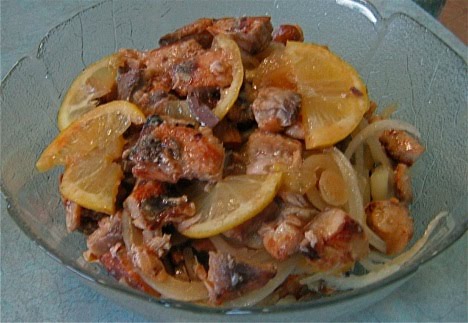
Mackerel Nanbanzuke

This recipe was recommended to me when I wanted to make smelt. Very sustainable, smelt. Small and fishy, like sardines. I wanted to form an opinion on the fish, having never tried it before. Unfortunately, I looked in three supermarkets and one fish shop the day I wanted to make this and suddenly all the smelt had disappeared from St. John's. Who knows why? Here one day, gone the next. That's definitely more understandable with less sustainable fish. Probably it just didn't come in that regularly because not many people buy it. I mean, how many people go out of their way to buy the reject fish that most people don't want?

I did find fresh mackerel at the Fish Depot downtown, and bought some of that. Close enough for jazz. It got chopped into bite-size pieces. The other nice thing about this recipe is that it meant I got to buy a bottle of sake (Japanese rice wine). I don't particularly like drinking this sake (there was only kind, the Hakatsuru draft sake, at the liquor store), but it's great for cooking and means I need to come up with more Japanese recipes to use it up.

Ingredients:
2lbs mackerel
1 inch ginger, grated
1 tbsp sake
cornstarch (potato starch is more traditional but cornstarch works the same)
1/2 cup vinegar (it just says "vinegar" but rice vinegar is probably standard. Regular white vinegar worked fine, though)
1 1/2 tbsp sugar
1/2 tsp salt
1/4 tsp soy sauce (or tamari)
1/2 an onion, thinly sliced
1 lemon, quartered and thinly sliced

1. Sprinkle the bite-sized pieces of mackerel with the sake and ginger...hmm...the recipe says to then pour out any liquid. I figured I'd toss the mackerel a little in the sake to make sure it got all over the fish.
2. Dust the fish with cornstarch (or potato starch) and deep-fry it in hot oil until lightly browned. I'm not such a huge fan of deep-frying, and mostly just afraid of over-cooking or not cooking enough, or not having the heat right. When deep-frying is done right by someone who knows what they're doing, it's a good way to cook. By me? Not so good. So I decided to fry in about 2 tbsp of oil. The pieces were small and they cooked quickly. I tried really hard to not overcook them and make them tough. I didn't want to just sear the outside, though, and leave the inside uncooked. Delicate balance. I think I fell off the proverbial see-saw, unfortunately. Searing didn't make a whole lot of sense, in retrospect, with such small pieces of fish.
3. Toss the hot fish in the combined sugar, salt, vinegar and soy sauce mix in a bowl. Then layer some onion slices, some lemon slices and then some fish. Repeat the layering until you run out of slices and fish. The recipe is a bit ambiguous about when to layer and when to toss...after the layering? Before the layering? I did a bit of both to be safe.

The recipe is to be served warm immediately or cold the next day, but I highly recommend the cold the next day option. The sugar from the vinegar, sake and the added sugar itself soaked into the lemon and kind of candied it. I wanted to keep eating lemon like a snack. Kind of like if lemonade came in fruit form. The fish was mild enough that the vinegar stuck out, and made a good pairing with the simple flavours of the Korean jap chae. Sesame didn't really go well with the fish, though, so I think a bowl of steamed rice would be a better idea. The noodles benefited from the vinegar, and I can't really complain about the fish. The other nice thing about waiting until the next day to eat the fish is that the fat solidifies and you can avoid it. Or you can eat it, or melt it over your rice or noodles. As you wish. I am far from traditional, and I apologize for that, but I don't think I messed the dish up horribly all things considered. The upside is now I'll know what the dish is when, or if, I see it on a menu. All in the name of cultural education...and dinner. Next time I see sea smelts...