Showing posts with label side dishes. Show all posts

Saturday, November 20, 2010

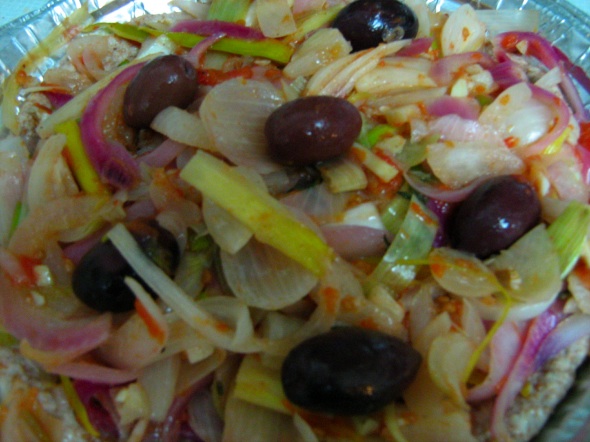
Pissaladière: "A la di Stadio"

This wasn't your fault, Josée.

If I could only follow a recipe properly this would have been fine, delicious even, but you asked for 2 lbs of onions and I only had 1 and a pound of leeks. And apparently leeks take a whole lot longer to soften than I thought, even when they look ready for the next step. I didn't even try one to make sure. Ultimate mistake. Honestly, I had to do was not under-cook them and this is the easiest recipe in the world. My canned (home-canned, so they taste like summer, not factory) couldn't even save this pissaladière.

So for anyone else who aspires to di Stasio greatness, here's how to make this dish properly:

1 tbsp olive oil heated over medium heat
2 pounds onions (you can use leeks but they MUST be softened to an onion-like consistency), cut in slivers
4 tomatoes, peeled, seeded and chopped
Some thyme
1 glove of garlic, finely chopped
salt and pepper

Add the leeks to the hot oil and cook about 5 minutes, then add the rest of the onions since I think they'll cook faster. Cook, and cook, and cook, and then when you think they're done, TASTE them, for the love of God taste them. If you have to chew and crunch they're not done. 20 minutes minimum. Just suck it up and wait. If the leeks and onions start to burn turn down the heat or add a tiny, tiny bit of water. You don't want to steam the onions and leeks, but better slightly steamed than slightly burned. You can also use 2 tbsp at the beginning instead of one if you must, OR do this in 2 batches because I think another potential downfall of my own was that the pan was not big enough. I'm thinking ENORMOUS frying pan next time.

Finally, when you can't wait any longer and the leeks are edible add the 4 seeded, peeled and chopped tomatoes, some fresh thyme or some dried (a small sprinkle, a big sprinkle, as you wish), some minced garlic (about 1 clove), and salt and pepper. Cook 5 minutes more. There shouldn't be a lot of liquid from the tomatoes, but you also don't need to drain them or anything. The juice will help deglaze the leeks and onions.

Preheat the oven to 350 Fahrenheit.

Now pour the whole thing on top of pizza dough or a flatbread dough (pita bread works too. I had a roti that I stretched out to pizza-like thinness. At least that worked...well...). Don't forget to oil the dish before you put the pizza dough/bread dough in or you'll never get to eat that dough. Mine got stuck and I scraped and I scraped and it never got eaten. Such a waste.

Into the oven for 25 minutes, or until you figure it's done and the sides of the dough haven't burned. You can also brush the top of the leek/onion mixture with olive oil so it browns a little, but that only helps if you didn't mess up the onion frying. Such a novice mistake. Optionally top with anchovies, olives or red pepper strips (preferably roasted, though the 25 minutes will go a long way toward roasting them) before popping in the oven. The salt from the olives collapses into the leeks, so at least it's properly seasoned.

I'm such a bad Quebecer. Messing up pissaladière...

Sunday, August 15, 2010

Candy Garlic and Salt-Roasted Zucchini With Deep-Fried Onions: Tiau

What the heck is a tiau? Nobody seems to know. I googled and googled, and then gave up and asked people, and still I have no satisfactory response. Chefs are always coming up with elaborate names for dishes, but I'm sure this one has a history. It's from Josée di Stasio's "A la di Stasio" cookbook, and this woman is neither careless not snooty. I think it may be related to the pattern created by stacking the vegetables, or it may just be "stacked vegetables" and have nothing to do with the pattern. Does that mean it's a big structure? A leaning tower of vegetables?

7 ingredients and some are optional:

Zucchini (mandatory if you're me)
Tomatoes (optional...unless you're Italian, I suppose)
Garlic (the best part of the dish, but in theory you could do without)
Onions (the guilty pleasure of the dish, but you could go without)
Olive oil (no where near optional)
Salt (you'll hate yourself for skipping this)
Herbes de Provence (I'm fresh out, so any fresh or dried herb works fine. I used oregano, but more traditional would be basil, parsley, thyme or sage, I suppose)

Oh, I lied. Add some fresh black pepper (it's optional, too, but it's a nice addition)

This is the ultimate gourmet but simple side dish (aka "Italian"). You get all your vegetables, but you load it up with a ton of olive oil. The garlic turns into crunchy candy, the onions into melting savouriness, and the zucchini into meaty, flavourful slices of my own personal heaven.
 The first time I made this I only had one small tomato, so I diced it up and scattered it on top of the stacked zucchini, but the next time I did it properly and sliced the tomatoes thick. The dish looked better, but the tomatoes were too juicy and acidic, and a little bitter, and made the meal disappointing. So I promote the diced tomato method or none at all. If you wait for an hour to cook something, and your anticipation and expectations build, it's no fun getting to the finish line only to discover that you get a flimsy certificate for the win, not a trophy, not even a small medal or goody bag - just acidic tomatoes.

Preheat the oven to 400 Fahrenheit. Slice a bunch of tomatoes (maybe), zucchini and (significantly less) onion into 3/8-inch slices (a little thinner is better because they'll cook a little fast, and if at the end of the hour you're getting a little antsy to eat, you can probably pull the dish out a little early. An hour's an awfully long time sometimes).

Mince the garlic. Don't chop. Normally I just finely chop when it says mince. My garlic press is junk. It does odd things to the garlic and kind of makes it seem like spaghetti squash the way the tendrils have a strange texture. In this case, you need to mince. The garlic needs to be that thin to roast properly and become delicious bundles instead of bitter pieces (for those who don't know, a mince is just a very, very, very, very fine chop, and home chefs generally use a garlic press to achieve it).
Take a large baking dish (or two if you love leftovers like me - makes great roasted vegetable sandwiches the next day) and line the bottom with the onions, half the garlic, a sprinkle of good salt, your herb of choice, and some grinds of fresh pepper. Then pour over about 2-3 tbsp of olive oil. I've never actually measured this. You just want a fair bit. This is Italian, after all, so add lots. Make the dish correctly the first time, and then play with amounts the next.

Then stack the tomatoes and zucchini (green zucchini and yellow if you can find them, just to make the dish look pretty) in a way that looks artistic on top of the onions. Sprinkle with the remaining minced garlic, some more (a generous amount) of salt, some more of your herb, some grinds of black pepper, and another 2-3 tbsp of olive oil. Do make this recipe with less oil you could put all the vegetables in a large bowl and add a few tablespoons of the oil. Then mix it in with your hands, and THEN place the onions and garlic in the baking dish, and top with the stacked tomatoes and zucchini.

My garlic clumped together because minced garlic doesn't really like to sprinkle...this was amazing. I don't think I'd pre-toss the vegetables just for this reason. The garlic needs the oil to roast well and mellow out, but if you toss it with the other vegetables it would spread out properly and not turn into clusters.
Don't over-bake this. Stick it in the oven for 1 hour. It may need a bit more time if your vegetables are thick, but probably not. With the tomatoes in it, there's not a big chance of the dish drying out and things getting stuck to the bottom, but even if you don't use a lot of tomatoes, like I did the first time, there should be enough oil and liquid from the zucchini to create a pool on the bottom. THAT's why the onions are so incredible. They've sat at the bottom the whole roasting time and soaked it all in. So when you serve the dish there should be puddles of oil and onion and the latter is undeniably delicious. It's basically become onion confit, but without the sugar that's usually associated with it. Olive oil deep-fried onions...

Deep-fried garlic is not as exciting, and neither was the tomato, but my lovely salted zucchini....I think I ate a whole dish of these, and was very thirsty afterward. Once, I burnt the dish a little and the onions on the bottom charred! It was kind of like onion chips, though. It will probably give me cancer, but it also gave me so much joy. Toss up?

Friday, August 6, 2010

Vietnamese Hmong Spicy Eggplant

I found a new, wonderful website. It's not new, but it's new to me: VietWorldKitchen. I was reading about pho', but then I saw this recipe, and it basically made my day. Maybe it was a slow day, but, oh, how I love eggplant. I didn't have any scallions or cilantro, and I only had dried chilies, so I kind of massacred the recipe, but it worked out well in the end, and I got to use my mortar and pestle, which is basically my goal in life.

I boiled my eggplants whole in some water, turning them to cook them through (they were the long, thin kind, so slightly less bitter than the big purple ones. They were at a very good price at my farmers' markets). Then I let them cool while I chopped some fresh mint (it's what I had. I didn't know if it would be a good replacement for cilantro, but I figured I'd give it a go. Oh, I also threw 8 red chilies into the eggplant-boiling liquid to resuscitate them. The recipe calls for fresh, but no way was I going to go out and buy eight chilies when they probably wouldn't even end up being the right kind anyway. So I sliced my resuscitated (and slightly boiled...) chilies open, got rid of the hot seeds (the seeds don't add flavour, just burning heat) and threw the flesh into the mortar and pestle with the salt and mint.  I just skipped the scallion, but I could have added some diced shallot if I'd wanted.

Now the fun part - the mashing. You crush it all up with the pestle. There is good mortar and pestle technique and then there's bad.  Mine is lacking. I watched an episode of Poh's Kitchen (you can find the podcast on iTunes for free) where she talks about it, but it's a small screen on my iPod and I'm maybe a slow learner. Anyway, everything got mashed in the end, and that's the point, really. You're now supposed to mash in the peeled eggplant, so I mashed a little at a time, and then just mashed in another bigger bowl (carefully!). The above picture is what came out. Oh it was so good. My chilies weren't Thai chilies so the heat was different, but my goodness it was hot. Now I love heat. I LOVE heat, but this was really, really hot. I ate a lot of it anyway, because the flavour was still SO good (my tongue could still find flavour through the slightly mind-numbing heat), but if you are scared of heat, I'd say use 2-3 chilies only. You're missing all the fun, and colour, but you won't have a fit on the flour. Not that I did.

Oh, the mint worked out nicely in the end.

Friday, July 23, 2010

I Swear It's Better Than It Looks: Boiled Eggplant Sautéd In Lamb Fat

Remember how I love eggplant? There's something absolutely delicious about how slimy it can be. It becomes soft and mushy and very mild. Different kinds, especially the long, thinner purple Asian ones, aren't as bitter as the regular pear-shaped ones. Slimmer is not always better, but it seems that in this metaphor the larger ones are bitter about their bottoms.

All joking aside, there was still a fair bit of lamb fat in the skillet after sauté-ing my potatoes, and I hate letting things that great go to waste. So I decided to sauté the eggplant that I'd boiled whole (got the idea from a Vietnamese recipe blog when researching pho) in what was left of the fat. Well the eggplant sure sucked up the leftovers! It actually started to burn. So that's why Indian and Chinese eggplant dishes are so luscious...they need a ridiculous amount of oil or fat to keep the eggplant from sticking to the wok or pot!

The result? The eggplant was bland, even with the oil. Only the texture was different, becoming a bit more slimy (which I actually like. Maybe it's an acquired taste, like oysters) with the additional oil. I did a comparison with some un-sautéd, boiled eggplant to be sure. So what I ended up doing was adding a bit of chaat masala for flavour. It was a cheat baigan bharta, but the mango powder ended up being delicious and there was more than enough salt in the masala to bring out the flavour. Now I have leftover eggplant for amazing sandwiches. I'll just sprinkle on a bit of chaat masala, add a few more vegetables and some puréed chickpeas, and die happy.

Friday, July 16, 2010

Farmer's Market Meets Kim Phat: Garlic Scape and Oyster Mushroom Risotto with Grilled Fish

"Rice, say the Italians, is born in water and dies in wine"
-Much Depends On Dinner

This is a perfect summer meal. The ultimate, light, comfort food topped with fresh grilled fish, all seasoned with top quality fleur de sel and organic sprigs of rosemary.

I don't use a recipe for risotto when I just make it for myself. This was not meant to be the word's greatest risotto, but in true Italian fashion, it was meant to be simple, filling, and delicious. I know a risotto is delicate and can only handle a certain number of ingredients and flavours - it's not a stir-fry where you just throw in whatever you have. I like a simple flavouring of garlic and mushrooms + one herb, in this case rosemary. I also had sage and lemon balm but sage I would probably have had to chop, and lemon balm I was worried would make it too acidic. I think the lemon would have been tasty for another time, though, especially with the fish, but it just wasn't the flavour I was going for that evening.

So here was my easy risotto strategy, a far cry from tradition, but also a far cry from being hit over the head with a rolling pin by an Italian Grandmother:

Ingredients:
2 cups basmati rice*
2 tbsp garlic scapes pesto (just puréed garlic scapes with oil and salt)
1 small white onion or shallot (optional)
1 large package of oyster mushrooms, roughly chopped**
The dregs (about 1/3 cup) of a bottle of dry white table wine (Quebec's own 'Orpailleur')
some (about 1/2 cup) sweet pho' ga broth (leftover from some Vietnamese chicken soup)
4 cups water***
a few whole sprigs rosemary (or sage, or basil, or parsley, etc., chopped)

Some small silver fish (4-12, depending on the size), like mackerel, sardines, or sea smelt****

*I know! It's not arborio. I just wrote an article on rice for Spezzatino magazine, so trust me, I know ALL about rice, and why I shouldn't have used basmati here. Basically the basmati doesn't break down into starch like arborio, vialone nano, or carnaroli, but it's what I had, so I combined my Indian and Italian rice-making skills with good results.

**cremini work fine, but "fancy" recipes will specify porcini or shiitake for flavour. Chanterelles would be spectacular, but I went to Kim Phat, the big Asian specialty store on Cote-des-Neiges, known to be the best in the city, and got ridiculously well-priced oyster mushrooms. Everything's just marked "fruit/vegetable", though (even some of the meats and fish!!), so you've got to know your produce. There were a whole lot of things that actually were vegetables that even with a sign giving their names, I had no idea what they were. Radish? Turnip? Cucumber? Sweet? Sour? Who knows.

***I would normally use vegetable or chicken broth here but I tasted the garlic scapes and onion mixture after it had cooked for awhile, and I thought it was plenty salty for the risotto. I also didn't want to overpower the mushrooms with a lot of sodium. Next time I think I'd go 2 cups broth, 2 cups water.

****If you want to be unsustainable, you can use tilapia or sole, but you should probably hate yourself for it. If the first three fish I listed smell fishy, they're not fresh. The stereotypes around them are unfair. They're also VERY affordable. Honestly, I got 12 sea smelts for $1.20. That is ridiculous. At Kim Phat you need to be very careful, but if you choose wisely, you can get very good quality, very well-priced fish. Avoid the shark...

Directions:
It's weird heating a big pot over medium heat with nothing in it. When I added the garlic scape purée once the pot was hot, I thought everything was going to burn. I stirred, though, and it was all fine. The oil in the scapes did its job and made everything not stick. Then I added the onions and stirred to coat those in the oil too.

Yes! Made it! 5 minutes of light stirring later, I added the chopped mushrooms. You don't want big pieces or they won't cook evenly, but you don't need to be too particular about the size, as long as the pieces are roughly the same.

Now the mushrooms should cook for a good 5-7 minutes to let the moisture evaporate out of them. The pot should be getting a bit dry, but nothing should be browning too much. Now you add the rice and stir it to coat in all the juices and oil for about 30-45 seconds. I had actually washed my rice Indian-style to get the starch off of it. I'd then let it soak in some cold water for about 15 minutes while the rest of the dish was cooking to this point. So I had to drain the rice and then actually let it cook for about 2 minutes to get all the water out of it. I don't really know why I soaked it for so long. I mean, the point of that is to keep the grains separate when they cook up, but for risotto they need to kind of stick together. I suppose it was the Indian in me. Maybe in my little toe.

You have to get all the water out so that when you add the wine there's a big cooking sound-effect: A big whoosh of deglazing aural beauty. You want the wine to boil, so you may need to up the heat to medium-high for a minute, and then turn it down to medium-low to simmer once the wine is added.

Now there's the labour-intensive way to do this or the not-so-labour-intensive way. Traditionally, you keep the rest of your liquid, about 6-7 cups of broth or water or a mixture of both, in a saucepan on medium heat. Then you add it 1/2 a cup at a time, stirring after each addition, until most of the liquid is evaporated. Then you add the next 1/2 cup. Repeat until all the liquid is used or the rice is tender. By keeping it hot this way you don't need to wait for it to heat up every time you add some to the rice for it to be absorbed. Adding it bit by bit feeds the rice slowly, which is what it needs to become perfectly al dente, yet creamy without becoming mushy from drowning. I figured that since I was using basmati rice, I wasn't going to get the perfect texture anyway, so I just added the 4 cups of liquid and the sprigs of rosemary at once, brought the pot to a boil, covered it and reduced the heat to VERY low (like my Indian basmati recipes say to do) for 18 minutes (normally it's 20, but the rice had already cooked a bit in the wine and onions).

After 20 minutes I kept following my Indian rice recipe and removed the lid, fluffed the risotto, and recovered for another 5 minutes (up to 10 if there's a lot of liquid). If it looks dry, you can add a little more liquid, but not too much, since basmati will get mushy quickly. Gelatinous rice is not delicious when it's supposed to be risotto.

During the first 18 minute cooking time I'd rinsed my fish, dried them, and sprinkled them with fleur de sel. That's just a fancy name for a specific type of large-crystal salt from France. Maldon salt, kosher sea salt, anything big (not pickling salt) all work fine. Fleur de sel is supposed to have a more delicate salty flavour. I just like it because you don't need to use a lot of it to get a lot of flavour. It's really popular here in Montreal (it is French, after all) so I wanted to see what all the fuss was about. Each crystal breaks apart into a luxurious mouthful of flavour. It feels like a guilty pleasure, like I shouldn't be eating that much salt, but it's really not very much since the flavour is so intense. I better like it, because my small container of it will last a long time.

That's honestly all I put on the fish. I was just going to put them on the grill, so it didn't need any oil. You can use a pastry brush to coat your grill in oil (not the fish, the grill), but with my indoor grill I don't it.

During the second rice-cooking time (5 minutes) I added the fish to my pre-heated grill. It took a few batches, but the first one was the one I needed to line up time-wise with the risotto. The nice thing about risotto, too, is that you can leave it covered for a little while on a different stove burner (a cold one, not one that still has heat coming from it) and it won't burn on you, unless there really isn't enough liquid in there. Anyway, the fish grilled in about 5 minutes. The sea smelts I used were very small so they didn't need a lot of time. When they were browned on the outside, they were done. I bit into one, the skin was opaque, not transluscent, but it wasn't too chewy or over-cooked. That means done to me. You just need to be careful of the vertebrae. If you bite carefully you can bite around it and then remove it without much fuss. If you try to break it, though, it gets trickier and messier.

Big scoop of risotto, a few sea smelts, maybe three crystals of salt, and a sprig of rosemary to garnish.

Summer...mmm...

Friday, July 2, 2010

Best Recipes of 2010? Um, no ("Cooking Light", How Far You've Fallen In My Eyes)

I have two very good magazines that I picked up randomly at grocery stores a long time ago in highschool. You know when you're waiting at the check-out and you see these beautiful pictures and you browse, but rarely buy. Magazines are not cookbooks, so the amount of quality you get for your money is not as high, in general. Sometimes, however, maybe once in a blue moon, there are pictures that are just to die for. I do admit to having bought a magazine for the gorgeous picture of just one recipe on the front cover. I generally try to look through and make sure there are other recipes I'd want to try, to justify the purchase, but light versions of banana cream and custard pies are sometimes impossible to resist.

In these rushed decision purchases I've only ever bought Cooking Light. Other publications are aimed at mothers, and I'm just not attracted to "20 Minute Meatloaf: A World of Variation" and other such things. I haven't bought a magazine in a long time, mostly because I don't really go to big grocery stores anymore, but when I saw Cooking Light's compilation of the best recipes of 2010 when I was home over Christmas (where are not so many small grocers or markets from which to buy my foodstuffs) I figured it was a safe bet. Surely a magazine that had given me some truly delicious recipes on other occasions would give a great "best of..." version. The recipes all looked fine...just fine, not great, but I held out on faith in a brand and added the magazine to my cart.

So this was the first recipe I tried - Spiced Potatoes and Green Beans. It resembled a lot of the Indian recipes I had been making lately, so I figured it would be great. I also love using new mexican chile, and I have some dried ones sitting in my cupboard waiting to be used. What an opportunity. Quelle chance (this is horrible French. Never use it...).

Unfortunately, no, this was not a stupendous recipe. If I published a magazine of all the recipes I've personally made in 2010 this recipe would not be included. I think the focus of Cooking Light has changed. Since this disappointment I've looked at other recent editions, and some published books including "The Best of Cooking Light" and been really upset at all the cheats they use. Like fat-free caramels to make an icing. "Healthy" is not what these caramels are. Yes, they're "low fat" but I don't want to put that in my body. They call for fat-free mayos and sour creams. These are pretty standard, and do get the fat content down, but my biggest complaint with the recipes is that they're just not that adventurous. It seems like the editors are now catering to the same market as "Canadian Living" and "Chatelaine", just making things a little less fatty. The "ethnic" ones aren't particularly exciting, being rather North American-ized versions of the originals. In the magazines I'd bought years ago they'd had some great, authentic recipes along with stories of families with different cultural heritages making these traditional recipes in North America, celebrating different customs, and generally being entertaining. Still, it's all about flavour, and I've got a few more recipes to try before I say, decidedly, that this isn't a great publication anymore.

Anyway, here's the recipe, in case you're looking for a recipe that's not spectacular, but not hard to make either.
Ingredients:
1 New Mexican Chile (It didn't say if it should be fresh or dried, but it's impossible to find fresh ones, so I figured it had to mean dried. New Mexican Chilies are pretty mild, and in a pinch you could replace the one in this recipe with another large chili. Anaheim would be a good choice)
2 tbsp canola oil (maybe it was worse because I skimped on the oil. Really, potatoes fried in more oil get a better crust, but even then there wasn't a lot of flavour - spice flavour - to season)
1/2 tsp brown mustard seeds
1 big onion, finely chopped
3 cloves garlic, minced
1 tsp ground cumin
1 tsp ground coriander (I even ground fresh ones but they couldn't save the recipe. I think next time I would toast these in a frying pan over medium heat until they're aromatic, and THEN grind them)
1 tsp fresh ginger, minced
1/4 tsp ground turmeric
1 pound potatoes, cut into small chunks (I even used yukon gold like they suggested. You can also use red. I don't think it makes it any better. I think you need more spice for the amount of potato called-for. I weighed mine, so I know I had the called-for ratio)
1/2 cup water (now here's where the recipe could be automatically improved. Try chicken or vegetable broth instead of water. The trend in restaurants would be to use duck fat, but that's just ridiculous. No Indian would use duck fat. Ghee yes, duck fat, no...an Indian cook would laugh in your face...unless it was Vij in Vancouver, but there are many reasons I don't care about ever eating at that restaurant)
3/4 tsp salt (I usually skimp on salt, but don't skimp in this recipe. It's already skimped-on)
8 oz asparagus, cut into 1" pieces (the original recipe is for green beans but I know this didn't make my recipe any worse)
1/4 cup fresh cilantro

You need to process or blend the chile in a coffee grinder, blender or food processor, but again, the recipe doesn't say if it becomes a paste (fresh chilies) or a powder (dried). Bad editing?
Then heat the oil over medium-high, and when hot, add the mustard seeds. 30 seconds later (I thought this was going to be a good recipe because they did the Madhur Jaffrey-style procedure or sauté-ing things for 30 seconds, or 1 minute, or very precise amounts of time per spice and per ingredient addition. Alas, no) add the onion. Stir for 2 minutes, then add the chile, garlic, cumin, coriander, ginger and turmeric. Stir for 30 seconds then add the potatoes. Stir to coat for 2 minutes, then add the water and salt. Bring the pot to a boil, cover, reduce the heat to medium-low and simmer for 8 minutes.

The potatoes should be tender. Then add the asparagus, re-cover, and cook for 5 minutes more. They shouldn't be lifeless, the asparagus. Leave them just a little crisp, but at a point where you won't have trouble chewing them. Then stir in the cilantro. If there's excess liquid, remove the lid and boil it off to a consistency you can live with. There are many things you can live with. Fortunately, bland potatoes are one of them.