Showing posts with label South Indian. Show all posts

Monday, January 3, 2011

3rd Annual Christmas Extravaganza: South Indian Dosa to Scoop Up Your Pork Vindaloo or Saag

Dosa is the easiest wrap to make ever. I don't know why more people don't eat it. It's a little coarse from the ground lentils, a little tangy, and deliciously sponge-like. Lots of people buy tortillas at the grocery store that come with so many preservatives and things you wouldn't really want to put in yourself if you looked at the ingredients list. Then other people buy things like tortilla presses, or even crepe pans and combine either hard to find ingredients or just lots of ingredients. Most people with wheat sensitivities just stick to sad, sad rice cakes.Traditionally dosa are eaten in Southern India with breakfast and lunch, but I keep having it for dinner. Kind of like having cereal for dinner, but less refined sugar and a lot more protein. It's just lentils and rice after all.

Dosa has 3 essential ingredients. Sure, it won't be as sweet as a crepe (though you could add sugar, I suppose), but it's about the most natural gluten-free wrap you'll ever make. Now "raw" food dehydrating, no kneading, no pressing, and it's as easy and fun as making pancakes. You can make the big elaborate cone-shapes one like you get in restaurants but actually making them pancake-sized helps them cooperate and be less brittle and fussy.
Ingredients:
3 cups basmati rice
1 cup urad dal ("black gram", but the black skin is removed, leaving you with something that looks like a very small split pea. It's easily confused with other kinds of dal such as moong dal, so make sure you ask)
1 tsp salt
1 tsp fenugreek (optional)

Instructions:
Soak the rice and dal in separate bowls for at least 6 hours on the counter. Add 1/2 tsp fenugreek (optional) to each bowl. The rice and dal should be covered by at least 1 inch of water.

Drain the water, rinse the rice and dal thoroughly, and place them in a blender or food processor along with 1/2 cup water. Add more water if you need to so you end up with a thin batter somewhere around a thin pancake batter or thick crepe better. I think too thick is worse than too thin, but there'll be lots of opportunity to add more water later, so for now err on the side of too thick. If the batter won't blend because it's too thick, don't be scared to add more water.

Pour the batter into a bowl and add the tsp of salt. Now cover the batter and leave it to ferment at room temperature for 12 hours. After that you can put it in the fridge if you don't use it right away. I haven't noticed any problem with keeping it a few extra days in the fridge. It doesn't go bad that quickly. I also figure that in India it would go bad more quickly, but this seems like the kind of batter you just leave lying around fermenting and it's okay for a good while.

Heat a skillet or electric frying pan like you would for pancakes and add a tiny bit of oil to the pan. In my last dosa recipe I used a much more complicated system of wiping down the pan with water and all but I don't think it's necessary. Instead, just pour out the batter a tablespoon at a time and then use the back of a spoon or ladle to swirl the batter outward in a circular motion rom the middle of the circle of batter to the edges. If holes appear that's fine. You can try to fill them in with drops of batter but the fine, embroidered look of the hole-y crepes is beautiful.

Cook for about 5 minutes or until you can get a spatula under the dosa to flip it. The edges should be slightly browned. The bottom should be a light brown. Cook a few more minutes. Done. You can do a few dosa at a time if you make them small enough and your frying pan is big enough. Normally you'd do big dosas for each person but the small one is more like giving soft-shelled tacos to your diners instead of a big burrito shell. that way you can also put different fillings in each one. Especially for the Christmas Extravaganza, it made sense to do smaller ones, so no one took a whole meal's worth of pork vindaloo or saag. I think I probably took a meal's worth of saag...but it is my heaven, after all.

Saturday, October 16, 2010

Sambar -- Take 2 (No, Not Samba. Wrong Continent)

I'm convinced that in Mexico you have to dance salsa when they make salsa, but what if the country of the food and the dance don't match? I'm not so foolish to believe that South Indians dance samba when they make sambar. In fact I'm sure they dance bhangra instead.

God, I hope they do...Check out the 1:57 minute mark. It's actually a really hard dance...

Maybe I danced around my kitchen a little while I was making this...maybe. It was my second sambar recipe, and if you want to make sambar, use my first recipe because I got this one online and it was a bad recipe, which I didn't know until the end. Partly it was probably my lack of tomatoes' fault, but mostly it was the recipe.

1 cup toor dal, but I used skinless urad dal, which is definitely wrong)
2 tbsp channa dal   
1 bunch coriander leaves 
2 tbsp coriander seeds
1 bunch curry leaves
ginger (all it said was "ginger" so I went with the standard 1 inch piece)
2 cloves garlic 
1 tsp asafetida (I assumed it should be grated, because that's just what you do. Explicit this recipe was not)
1 tsp jaggery (this is a dark sugar so I used regular sugar with a tiny, tiny drop of molasses) 1 tsp fenugreek
1 HUGE zucchini, chopped into 1/2-inch cubes, or really, however you want (but you can use almost any vegetable you want - potato, beans, caulifower, etc)
1 tbsp mustard seeds
2 tbsp oil 1 large onion, diced
6 dried red chilies 
1 tbsp rice salt to taste 
1/2 cup tamarind water (one golf-ball sized piece of tamarind soaked in boiling water for 30 minutes, then strained through a sieve) 
1 medium tomato, chopped 
1 tsp turmeri
    I made the sambar masala just fine I thought, even roasting the mustard seeds, fenugreek seeds, cumin seeds, and black peppercorns longer than the coriander seeds, red chilies, rice, and channa dal (which is traditional, and which is why I thought this would be a good recipe in the first place. Poh, from Poh's Kitchen taught me this is important in an episode with Indian spice master Ragini Dey). I'd also never seen a masala with oil in it since it wouldn't keep a long time.

    The middle part of the recipe was less "fine". See you have to make the sambhar masala and then you have to use some of the same ingredients in the dish itself, but the ingredients are only listed once, so when I got down into the meat of the recipe (it's vegetarian, yes) I had no idea how much of certain spices to add...so I added the same amount again. WAY too much spice without anything to soak it up! Spices are delicate and while you can play with them, you can't just double them haphazardly. Shame on you, recipe.

    I finished the recipe just fine as well. I threw in some zucchini for texture and vegetable (yes, "for vegetable"). I'd even soaked a whole piece of tamarind and used my ENORMOUS new sieve to strain out the stringy bits. Oh it was beautiful, beautiful sieved tamarind. Well, the rest of of the tamarind is in my freezer waiting for the next time I don't mess up sambar...or a samba, or a salsa. I hate messing up a salsa...the dance, I mean. It's embarrassing. You feel like you're wasting the guy's time. He could have spent the last 5 minutes of his life dancing with someone else, someone with better technique, hands that fly through the air, feet that do extra steps that no one really teaches you. He could have danced with someone who'd flirt with him. I'm not going to flirt with you, arrogant dancing partner who decides I'm a waste of his time mid-dance. With food and dancing you need to have some self-respect.  

    Oh, here's a hilarious video on learning to dance bhangra. Indian aerobics shows are much cooler than North American ones. Grapevine, anyone?

    Tuesday, October 5, 2010

    South Indian Sambar: Tamarind, Lentils and Spices

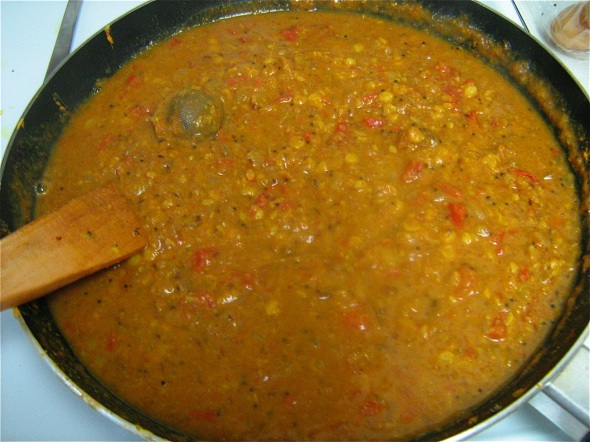
    I love making recipes when I don't need to go buy any ingredients. It's only kind of fair because I happen to have a lot of weird ingredients that normal people don't usually stock in their kitchens (chana dal, asafoetida, curry leaves, and even soaked and sieved tamarind in my freezer), but this recipe is exactly why I love Indian cooking - you take a ton of spices, cook them according to a formula and end up enjoying food you were maybe a bit skeptical about trying in the first place. Oh, and your kitchen smells amazing.

    Ingredients:
    Sambar Powder:
    1 tbsp coriander seeds
    1 tsp chana dal (like split yellow peas, but not exactly the same. Any split pea substitution is fine, but it won't be exactly the same)
    1/2 tsp urad dal (look in South Asian stores and have some good conversations like I did)
    1 tsp cumin seeds
    1/2 tsp asafetida, grated (this stuff smells like onion...sort of...it's sticky and gets all over your hands, but it's so good for digestion and is everywhere in South Indian cooking)
    2-4 dried red chillis
    1/4 tsp black pepper
    1/4 tsp mustard seeds
    1/4 tsp fenugreek seeds (called 'methi', these are little yellow pebbles)
    Sambar:
    1 cup toor dal. Okay, this is the one place I cheated. I just gone on two major trips in search of urad dal and chana dal and not looked for toor dal. Apparently nothing can replace toor dal in sambar, says the internet, but screw the internet. I used chana dal...it was nutty and delicious and nothing like other sambars I've had, but I'm okay with that. The next time I stumble upon toor dal I'll buy it.

    1 lime-sized chunk of tamarind
    2 medium onions, chopped
    2 medium tomatoes, chopped
    1 curry leaf sprig. Yeah trying finding fresh ones...that's maybe a losing battle in Montreal, but dried can be found fairly easily. Cross your fingers and hope they're fresh. Me, I just had a bunch of sort of crushed old ones so I stuck them in a tea infuser (you don't want to eat these guys) and tossed them into the sambar.

    1 tbsp chopped coriander leaves
    1 tsp salt 
    3-4 cups water

    Seasoning:
    1 tsp oil, 1 tsp ghee (or two tsp oil)
    1 tsp mustard seeds  
    1 tsp cumin seeds
    1 pinch asafoetida (grated and then pinched, presumably)
    1/4 tsp turmeric powder

    Instructions:
    Put the sambar powder ingredients in a small frying pan on medium-low heat. When you can smell them and they start to darken a little, take them off the heat and grind them to a fine powder in a mortar and pestle, blender or food processor. All these spices should be whole, but if you have, say, ground cumin instead of whole, and you're stubborn about not buying the whole ones you can add the ground ones after you've toasted the whole ones before you crush everything together. The ground spices will burn if you add them to an oil-free frying pan with the others. Oh, and it's maybe a bit strange that you wouldn't cook the chana dal for the sambar powder, but that's pretty normal for rice and lentils in South Indian dishes)
    Soak the tamarind in warm water (very warm, but not boiling) for 15 minutes. Then take a fine-mesh sieve placed over a bowl and press the soaked tamarind lump through as much as you can. It's a real pain, it's true, but you want to get as much of the softened pulp through the mesh as possible. Throw out the hard material that's left, then add enough water to the pulp to give you 1 cup. 
    "Cook the toor dal in 2 cups of water until it's soft". I hate ambiguous instructions like that, especially with lentils that get mushy if over-cooked and chewy if under-cooked, AND every lentil is different, so mine took about 25 minutes, but if I'd actually used toor dal, who knows how long it would have taken. Probably I could have looked it up really easily...I'm up there with people who are too stubborn to buy whole spices, apparently. I'm such a hypocrite. Anyway, bring the water to a boil (after rinsing the dal in cold water a few times to remove any dirt or stones) and add the dal. Bring to a boil, reduce heat to medium or medium-low and simmer for who knows how long...

    In a large pot, heat the oil (and ghee). My favourite part: add the mustard and cumin seeds. It'll take them about 30 seconds to start to pop. When they stop, add the asafetida and turmeric powder, curry leaves, and chopped onions. Cook 5 minutes. Add tomatoes. Cook 5 minutes. Add 1 cup water. Add ground sambar powder. Boil. Inhale. Smile. Exhale.
     Mash the cooked toor dal (with a masher, a large, blunt object, or in a food processor. A blender will suck. It probably won't blend well unless you use something intense like a VitaMix. Add the dal to the spiced tomato mixture in the large pot.
     Boil for another 5 minutes. Add the tamarind pulp and salt. Stir and add more water if needed (it should be more like a soup than a stew, but the flavour gets watered down pretty quickly, so be careful, especially if you didn't work that hard at pushing the tamarind through the sieve). Boil for yet another 5 minutes.
    Turn off the heat, cover, and prepare dosa or idli, or get the rice that you started cooking 25 minutes ago (you did, right? I sure didn't...). When you're ready to serve, top the sambar with chopped coriander leaves. Normally every person at the meal would get a small bowl of sambar so you can garnish each individually, or give up from exhaustion and just throw all the coriander in to the hot soup to lose its colour and some of its flavour and nutritional clout  : )

    This is perfect to make with dosa because they take no time at all. Rice can be made in advance, but idli seem as though they may be a nuisance. I'll try that sometime and let you know.

    Sunday, October 3, 2010

    Mysore Masala Dosa

    This was the first time I ever "winged it" with an Indian recipe. I mean, it's not as though I threw the recipe out the window, but there was nothing that said "30 seconds later add the" or "2 minutes later combine the", as Madhur Jaffrey is prone to do in my favourite Indian cookbook. Actually the cookbook of hers that I have doesn't have many South Indian dishes. So I turned to the internet with its sketchy, and often missing, instructions for a recipe for mysore masala dosa - my favourite fermented rice and lentil crepe known for its slightly (to not-so-slightly) spicy potato filling.

    Ingredients
    3 cups boiled and slightly mashed potatoes
    2 cups chopped onions
    1/2 cup boiled peas (not really optional, but I didn't have any, so for me it was optional. For you, well, you can do what you want)
    3-4 finely chopped green chilies (I only had red. Well, oops, but that's what I'd bought in bulk at the farmers' market, so that's what I used)
    1/4 inch piece of ginger, finely minced
    2 cloves of garlic, crushed or minced
    3 tbsp oil
    1 tsp mustard seeds
    1 pinch asafoetida
    4-5 curry leaves
    salt to taste
    1 tsp turmeric 
    1 tsp cumin 
    chopped coriander
    1/2 cup grated fresh coconut (again, not really optional, but the fresh coconut options around the city are minimal, and I'm just one person anyway, and that's a lot of coconut to eat. So I kept my carbon footprint relatively in check...or at least let it balance with my purchase of Greek figs. So worth it).

    See, there were no actual instructions on how all these things should be put together, but with some other dosa cross referencing, I got the general idea. Besides, you'd rarely see an Indian cook with a recipe...but that Indian cook would probably have grown up in a household where such things as recipes were passed down from mouth-to-mouth, so to speak.

    Directions:
    Boil the potatoes. Boil them whole if you've got the time, since they slip easily out of their jackets and I think retain more of their nutrients if boiled with the skins on. If you don't have time, peel them and chop them into smaller sections. When a fork goes into them easily, remove them from the pot and either plunge into ice water to cool, or let them cool on their own while you're busy doing other things...

    ...such as chopping the chilies. I like to take the seeds out before I chop the chilies, since the seeds give pure heat and no flavour, but if you want that burning sensation to come quicker and don't care about the heat, leave them in and save yourself the trouble. Get all the other ingredients ready and measured. This goes pretty fast, so unless you are a chopping superstar whose spices are all alphabetically organized, be humble and do the mise-en-place. Oh! That includes peeling and mashing the potatoes. You CAN mash them after you've thrown them into the frying pan later, but it takes extra time and thing may burn while you're attempting to mash. Then if you're like me you know they're not going to want to mash and you'll start swearing at it and cursing your lack of a decent potato masher, when a slotted spoon would have been just fine if you'd actually mashed the potatoes before you'd turned on the heat...but that's just me. You are much smarter than that. Anyway, mashing roughly is fine. I kind of like the lumps because potato purée dosa has a less interesting, more baby-food-like texture.

    Okay, go! The oil goes in the large frying pan on medium-high heat. When it's hot, add the mustard seeds and asafoetida. Wait 30 seconds. With mustard seeds you always wait 30 seconds, well approximately. You wait for them to "pop" and in every recipe that apparently takes 30 seconds. Mine didn't pop...so I cried a little inside and turned up the heat. Maybe my pan wasn't ready yet. 
    Then add the ginger, garlic, chilies, and curry leaves and stir relatively frantically so it doesn't burn. 
    When everything is getting a little softened and brown a few minutes alter add the turmeric, cumin and coriander. Now you really need to stir since the dry spices will burn very easily. When it's stirred (it doesn't need to cook more than a minute) add the potatoes (pre-mashed!) and stir everything. The potatoes should turn yellow-orange from the turmeric. The oil will get sucked up, as though through a straw, into the potatoes and your masala is done. You can add a little water to thin it and make the potatoes a little more tender if they're a variety that's naturally starchy. Oh! Salt to taste! Very important! There's no other salt in this recipe and the salt really brings it together, so be generous. Garnish with chopped coriander (cilantro) and wrap in dosa. Die from joy from eating so luxuriously, simply, and healthy. Okay, maybe don't die, but experience some kind of blissful state. Please.

    Friday, October 1, 2010

    South Indian Dosa

    The South Indian Crepe. It looks a bit like a doily, I know. After about 4 days of mostly eating dosa I think I got okay at the technique.

    My first try looked like this:
    Not bad, but not the beautiful lattice work that I like. I experimented with making it thinner, sometimes ending up with gaping holes that needed to be filled in:
    but it was crisp and chewy. It's supposed to be bendy, and be able to fold around its fillings but mine never got that way, even 12 or so dosai later. Maybe my heat was too much, or I didn't use enough oil, or the batter was too thick, or too thin...Well, I'll keep trying. Since I'm allowed to eat with both hands (and/or utensils), it didn't really matter that the dosa was so un-bendy.

    It's really simple to make. It's just slightly fermented long-grain rice and lentils. Here's what you do:

    3 cups long-grain rice (basmati is perfect)
    1 cup skinless split urad daal (skinless black gram)
    3/4 tsp fenugreek seeds
    Salt to taste (a sprinkle or 1/4 tsp.)
    Oil of choice

    So it's maybe hard to find split urad daal. I went to a place in Pointe Ste-Charles (the equivalent of the Goulds in Newfoundland...kind of) and said I was making dosa and the man gave me a bag of dal. I said, "This is for dosa?" (This was before I actually had looked at a recipe), and he said "yes." Don't trust a man when it comes to Indian food.

    It was chana dal, which was fine, because I can make daal (the soup. The spellings of all these things are a bit ambiguous) out of that, and I used it as a tuvar dal replacement in the sambhar (recipe to come). Different flavour, but I like the nuttiness. Anyway, so then I went to Parc Extension and asked a female store clerk where the split urad dal was. "Skinless or not?" she asked. "Skinless, " I said. She pointed me to an unmarked bag around the corner. What's up with not labeling bags? She lined up her hands vertically as she shook her head. Oh! The one next to it! Another unmarked bag that was just a tiny bit lighter but otherwise identical. Yes, that one, she nodded.

    "Why do you know about urad dal?". Not "how", but "why", she had asked. I'm assuming she just used the wrong word, but the verbal slip was interesting. It made it seem as though urad dal is something I'm not allowed to know about, as if it's a secret.

    "I'm making dosa," I said simply. "I like South Indian cooking". I smiled, thanked her, and left. I like to think that she shared a secret with me.

    Directions:
    You need to make this the night before or start VERY early in the morning. The nice thing is, you don't need to make it all at once, since it just keeps fermenting on day 2 and 3. I'm not sure how long it's okay to let it keep going, but I felt comfortable using it up to day 4.

    Wash the rice and dal in several changes of cold water, swirling the grains around with your fingers like you would for perfect rice.  Drain it and add the fenugreek seeds. Add enough water to cover the rice and dal by about 2 inches. Soak overnight, or about 8 hours.

    The next morning, drain all the water again. Put the rice and dal mixture in the blender or food processor, in batches if necessary, and grind to a grainy paste. You can add a little water if you need to.

    Put the ground mixture back into the bowl you used to soak it and add enough water to make a batter. Mine was initially pretty thick, so don't be afraid to thin it out. It should coat a spoon thickly, but you're going to spread this very thin, so remember that it's a crepe not a pancake.

    Add the salt and then put the batter in a warm, dark spot, covered, for 6-8 hours. I put it in the oven with the door open on lowest heat. I would have normally just put it in with the light on, the oven turned off and the door closed but for the "dark spot" rule.
    Now the batter's ready. Stir.

    Get about 1/4 cup of oil ready in a bowl with a basting brush at hand, and take a paper towel dipped lightly in oil and spread it over the bottom of a large frying pan. The oil should be barely visible.
    Turn the heat to medium and let it warm up. When hot, take a 3/4 full ladle of batter and pour it in the middle of the frying pan. Now sweep the dosa in ever-expanding circular motions with the bottom of the ladle (plastic if the pan is nonstick!) until the dosa is about 8 inches (the size of a small cake pan) in diametre. Tiny holes are normal and just fine. Some kinds of dosa have them and some don't. It's personal taste and what kind of filling you have that determines if this matters.

    Once the batter is spread, immediately dip the basting brush liberally in the oil and drizzle it all over the surface of the dosa and also around its edges. Now hold the pan by its handle, lift up and swirl it to make the drizzled oil spread all over the dosa. Careful not to swirl the dosa right off the pan like I did the first (few) time(s).
    After a few minutes check the bottom of the dosa. It should be light brown. The first dosa sometimes isn't evenly browned, but don't worry. Years of pancake-making taught me this is fine, and the second batch will be more consistent. Flip the dosa. Cook 1 more minute, or until the bottom is lightly browned. I don't like it soft and chewy, so I made sure it really got enough cooking time, but I think I overdid it because then you're supposed to fold the dosa in half and let it cook 30 seconds more. This is probably an important step I skipped...

    You can eat dosa plain, or with coconut chutney. Since I'd have to buy a whole coconut to get a decently sweet-tasting chutney, I skipped it and just went with hot sauce. Very non-traditional. The second dosa was ready at the same time as my potato masala filling (recipe to come), though, so that one got all wrapped up burrito-style...well, cracked burrito-style. Still, delicious burrito-style. The next day I added sambhar. That was when everything in my world got a lot sunnier.

    To make the second dosa you need to run a paper towel under some ice cold water and rub it over the pan to remove any dosa debris and cool the surface. Apparently this makes your dosa not break as easily since the pan is cooler. Then proceed as before with a little more oil on a paper towel and 3/4 of a ladle of batter. So easy. 5 ingredients. Go forth.