Cook and whisk over simmering water, stirring frequently until sugar dissolves and the colour begins to darken (about 30 to 45 minutes). That's what the recipe says, but mine didn't darken so much. I used a different kind of miso and it was already fairly dark. So I just let it cook for 45 minutes and I was fine. You can't do this directly in the saucepan because miso shouldn't be boiled. It kills the good things in it, or so I thought. The double boiler is annoying, but worth it. After 45 minutes, remove the bowl from the saucepan and the saucepan from the heat and let it cool. Reserve 4 tbsp for the sauce below (the recipe only calls for 3 tbsp but keep 1 tbsp extra aside in case you need to make the sauce sweeter by adding more) and pour the rest of the cooled marinade over the cod in a large sealed container or covered casserole dish. Make sure all the cod is covered in the marinade, and if it isn't completely covered, try to remember to turn it at least once during its marinating period to make sure every part of the fish gets to luxuriate in miso. Place the fish in the fridge overnight or for at least 30 minutes.
Friday, September 17, 2010
How Do You Mess Up A Lemon-Butter Sauce?
Mais non, with me, the easy things become hard and the "any idiot can do it" things become disasters.
I bought fish at St. Lawrence Market in Toronto at 4pm. That means everything goes on special. I bargained and asked if the fish guy would give me an extra discount on the black cod if I bought some smoked salmon. Sure, $3 off per pound. What that meant was I could afford the black cod. I bought one fillet. Just one. Enough fish for 2 people. It only cost about $8. This is still ridiculous but if you've had black cod you will understand. Really you don't need a sauce for this fish. The flesh itself already tastes like butter. Just add a little salt and pepper and grill, bake, roast or broil this fish to perfection. The only thing you can even do wrong is over-cook it. It should fall apart at the touch of your fork. To me, this is heaven.
So by adding a lemon butter sauce I was probably asking for trouble. Why mess with a good thing, right? I figured adding a tiny bit of butter would enhance the natural buttery-ness, and as long as I didn't add too much lemon, it would contrast the sweetness. I searched long and hard for a good lemon-butter sauce recipe, which is stupid because it's so simple, but I had vermouth, see, and I wanted a sauce that would use that as well. I also didn't want to add any cream because a little butter is all my poor lactose-intolerant belly can handle. Oh, and I had no chicken stock, the recipe had to be just lemon, butter, oil, salt, pepper, vermouth and capers (I bought some capers because those go with fish and lemon sauces, right?
I can't even find the recipe I used but it had way too much lemon juice (1/2 a lemon's worth I think), too many capers (my fault, I think. It only called for 1/2 a teaspoon or something way too small, so I doubled it and probably didn't drain them very well. So it was pretty brine-y), and just a dab of butter at the end. I should have dabbed more, probably. I deglazed with a splash of vermouth, as called for, but it evaporated in about 1 second even though my temperature was at the right level. So I added another splash to create some actual liquid. Probably there should have been more to balance the lemon juice.
Worst thing was I still managed to under-cook the fish, only slightly better than over-cooking it. I wasn't too worried about under-cooking it because of all the lemon and the anti-microbial properties thereof.
Still, it wasn't great. It was way too lemony to taste the exquisite black cod. Less is more, Amie. Skip the sauce entirely next time and let the fish flavour shine.
Or follow a proper recipe, one that's published...in a book...or on a blog or website I trust. No more taking chances with black cod. It is far too delicious. At least the anise flavour from the top of the fennel was subtle enough.
I roasted some fennel and tomatillos. The fennel was perfect. The tomatillos made me cry a little, they were so bitter. I missed my Quebec tomatillos. No wonder no one buys them...they're often so disgusting...but my perfect ones from the market in Montreal...heaven.
Hits and misses, this meal. Maybe I'll get it right next time.
Friday, July 16, 2010
Farmer's Market Meets Kim Phat: Garlic Scape and Oyster Mushroom Risotto with Grilled Fish
This is a perfect summer meal. The ultimate, light, comfort food topped with fresh grilled fish, all seasoned with top quality fleur de sel and organic sprigs of rosemary.
I don't use a recipe for risotto when I just make it for myself. This was not meant to be the word's greatest risotto, but in true Italian fashion, it was meant to be simple, filling, and delicious. I know a risotto is delicate and can only handle a certain number of ingredients and flavours - it's not a stir-fry where you just throw in whatever you have. I like a simple flavouring of garlic and mushrooms + one herb, in this case rosemary. I also had sage and lemon balm but sage I would probably have had to chop, and lemon balm I was worried would make it too acidic. I think the lemon would have been tasty for another time, though, especially with the fish, but it just wasn't the flavour I was going for that evening.
So here was my easy risotto strategy, a far cry from tradition, but also a far cry from being hit over the head with a rolling pin by an Italian Grandmother:
Ingredients:
2 cups basmati rice*
2 tbsp garlic scapes pesto (just puréed garlic scapes with oil and salt)
1 small white onion or shallot (optional)
1 large package of oyster mushrooms, roughly chopped**
The dregs (about 1/3 cup) of a bottle of dry white table wine (Quebec's own 'Orpailleur')
some (about 1/2 cup) sweet pho' ga broth (leftover from some Vietnamese chicken soup)
4 cups water***
a few whole sprigs rosemary (or sage, or basil, or parsley, etc., chopped)
Some small silver fish (4-12, depending on the size), like mackerel, sardines, or sea smelt****
*I know! It's not arborio. I just wrote an article on rice for Spezzatino magazine, so trust me, I know ALL about rice, and why I shouldn't have used basmati here. Basically the basmati doesn't break down into starch like arborio, vialone nano, or carnaroli, but it's what I had, so I combined my Indian and Italian rice-making skills with good results.
**cremini work fine, but "fancy" recipes will specify porcini or shiitake for flavour. Chanterelles would be spectacular, but I went to Kim Phat, the big Asian specialty store on Cote-des-Neiges, known to be the best in the city, and got ridiculously well-priced oyster mushrooms. Everything's just marked "fruit/vegetable", though (even some of the meats and fish!!), so you've got to know your produce. There were a whole lot of things that actually were vegetables that even with a sign giving their names, I had no idea what they were. Radish? Turnip? Cucumber? Sweet? Sour? Who knows.
***I would normally use vegetable or chicken broth here but I tasted the garlic scapes and onion mixture after it had cooked for awhile, and I thought it was plenty salty for the risotto. I also didn't want to overpower the mushrooms with a lot of sodium. Next time I think I'd go 2 cups broth, 2 cups water.
****If you want to be unsustainable, you can use tilapia or sole, but you should probably hate yourself for it. If the first three fish I listed smell fishy, they're not fresh. The stereotypes around them are unfair. They're also VERY affordable. Honestly, I got 12 sea smelts for $1.20. That is ridiculous. At Kim Phat you need to be very careful, but if you choose wisely, you can get very good quality, very well-priced fish. Avoid the shark...
Directions:
It's weird heating a big pot over medium heat with nothing in it. When I added the garlic scape purée once the pot was hot, I thought everything was going to burn. I stirred, though, and it was all fine. The oil in the scapes did its job and made everything not stick. Then I added the onions and stirred to coat those in the oil too.
Yes! Made it! 5 minutes of light stirring later, I added the chopped mushrooms. You don't want big pieces or they won't cook evenly, but you don't need to be too particular about the size, as long as the pieces are roughly the same.
Now the mushrooms should cook for a good 5-7 minutes to let the moisture evaporate out of them. The pot should be getting a bit dry, but nothing should be browning too much. Now you add the rice and stir it to coat in all the juices and oil for about 30-45 seconds. I had actually washed my rice Indian-style to get the starch off of it. I'd then let it soak in some cold water for about 15 minutes while the rest of the dish was cooking to this point. So I had to drain the rice and then actually let it cook for about 2 minutes to get all the water out of it. I don't really know why I soaked it for so long. I mean, the point of that is to keep the grains separate when they cook up, but for risotto they need to kind of stick together. I suppose it was the Indian in me. Maybe in my little toe.
You have to get all the water out so that when you add the wine there's a big cooking sound-effect: A big whoosh of deglazing aural beauty. You want the wine to boil, so you may need to up the heat to medium-high for a minute, and then turn it down to medium-low to simmer once the wine is added.
Now there's the labour-intensive way to do this or the not-so-labour-intensive way. Traditionally, you keep the rest of your liquid, about 6-7 cups of broth or water or a mixture of both, in a saucepan on medium heat. Then you add it 1/2 a cup at a time, stirring after each addition, until most of the liquid is evaporated. Then you add the next 1/2 cup. Repeat until all the liquid is used or the rice is tender. By keeping it hot this way you don't need to wait for it to heat up every time you add some to the rice for it to be absorbed. Adding it bit by bit feeds the rice slowly, which is what it needs to become perfectly al dente, yet creamy without becoming mushy from drowning. I figured that since I was using basmati rice, I wasn't going to get the perfect texture anyway, so I just added the 4 cups of liquid and the sprigs of rosemary at once, brought the pot to a boil, covered it and reduced the heat to VERY low (like my Indian basmati recipes say to do) for 18 minutes (normally it's 20, but the rice had already cooked a bit in the wine and onions).
After 20 minutes I kept following my Indian rice recipe and removed the lid, fluffed the risotto, and recovered for another 5 minutes (up to 10 if there's a lot of liquid). If it looks dry, you can add a little more liquid, but not too much, since basmati will get mushy quickly. Gelatinous rice is not delicious when it's supposed to be risotto.
During the first 18 minute cooking time I'd rinsed my fish, dried them, and sprinkled them with fleur de sel. That's just a fancy name for a specific type of large-crystal salt from France. Maldon salt, kosher sea salt, anything big (not pickling salt) all work fine. Fleur de sel is supposed to have a more delicate salty flavour. I just like it because you don't need to use a lot of it to get a lot of flavour. It's really popular here in Montreal (it is French, after all) so I wanted to see what all the fuss was about. Each crystal breaks apart into a luxurious mouthful of flavour. It feels like a guilty pleasure, like I shouldn't be eating that much salt, but it's really not very much since the flavour is so intense. I better like it, because my small container of it will last a long time.
That's honestly all I put on the fish. I was just going to put them on the grill, so it didn't need any oil. You can use a pastry brush to coat your grill in oil (not the fish, the grill), but with my indoor grill I don't it.
During the second rice-cooking time (5 minutes) I added the fish to my pre-heated grill. It took a few batches, but the first one was the one I needed to line up time-wise with the risotto. The nice thing about risotto, too, is that you can leave it covered for a little while on a different stove burner (a cold one, not one that still has heat coming from it) and it won't burn on you, unless there really isn't enough liquid in there. Anyway, the fish grilled in about 5 minutes. The sea smelts I used were very small so they didn't need a lot of time. When they were browned on the outside, they were done. I bit into one, the skin was opaque, not transluscent, but it wasn't too chewy or over-cooked. That means done to me. You just need to be careful of the vertebrae. If you bite carefully you can bite around it and then remove it without much fuss. If you try to break it, though, it gets trickier and messier.
Big scoop of risotto, a few sea smelts, maybe three crystals of salt, and a sprig of rosemary to garnish.
Summer...mmm...
Tuesday, June 1, 2010
Halibut in Indian-Spiced Tomato Sauce: Judith Finlayson's "Delicious and Dependable Slow Cooker Recipes"
Rarely do I take a slow cooker recipe and turn it into a stove-top recipe. Usually I go the other way, preferring stewed foods to simmer for longer at a lower temperature, not to mention the no-stirring, fuss-less, set-it-and-leave-it advantages of the slow cooker.But sometimes a recipe looks so good and so tasty even though I just don't have the time to cook in the morning or early afternoon, that I have to make it anyway. Judith Finlayson really only puts good recipes in her slow cooker books, so when I wanted to make a spicy fish dish I even vetoed Madhur Jaffrey's bible, "Indian Cooking" in favour of a generically-named halibut in "Indian-spiced" tomato sauce. As if there are only a handful of Indian spices...Still, the recipe was not oversimplified, and because it was a slow cooker recipe originally, it called for whole spices instead of ground, which makes it more authentic in my books.
Ingredients:
oil
onion, diced
garlic, minced
gingerroot, minced
1 long red chili pepper, seeded and diced
2 whole cloves
2 pods of green cardamom (you can apparently also use white but I've never even seen white cardamom before)
1 2-inch cinnamon stick (mmm...delicious when it unfurls and you can suck the sweetness out like a lollipop)
1/2 - 3/4 tsp salt
1/2 tsp freshly ground black pepper
1 can tomatoes
potatoes, peeled and diced (a few medium-sized)
2 tbsp flour
1 tsp turmeric
1/2 tsp ground coriander
1/2 tsp cayenne
1 1/2 lbs halibut cut into 1-inch pieces
The deal with the fishmonger food fight was this:
Basically the halibut was too expensive so I bought lotte instead. Lotte is the French word for bellyfish. I would never have bought it if I'd known it was bellyfish, also known as monkfish. Very, very unsustainable, says Seachoice.org. Still, I'd specifically heard it was a good substitute for halibut in Indian recipes and here I was looking for just that. It was less expensive, and I knew the halibut wasn't exactly sustainable either, so I figured either way would be a bad choice, and this was maybe the lesser of two evils. In the end it was just my naiveté that resulted in a fight.
I said I wanted a pound and a half. The woman slaps a big bone-in fillet on the scale. It's a good 2 pounds. "No," I say, "Less, please." The woman gets noticeably angry. What did I do? I point to a smaller fillet. She says, "That won't give you enough. Do you want the bone removed?" I think about it..."Yes." I'd just have to remove it for the recipe anyway to chop the fish into cubes. "Well if you remove the bone it won't be enough," she stated bluntly. I insisted on the smaller fillet. "But you asked for a pound and a half." Yes, I know, but isn't it my right to change my mind? The customer is always right, remember? I really don't have a good idea of how much a pound and ahalf of fish is until I see it, and upon seeing it, I knew it was too much. She gives me this dirty look and says, "How many people is it for?" I say, "Four," and she gets exasperated and repeats, "IT's not enough!" I say it's going to be stewed so it's not going to be a standard portion per person. You don't need as much. She demands I tell her the whole recipe. Just give me the gosh-darn (edit...) smaller fish, and take the gosh-darn bone out. "Have you ever made this before?" she asked. "Yes!" I lied. "Do you want the bone?" "Yes! I will make stock!" There were no "thank-you"s or "have a nice day"s involved in this transaction. I took my bag of fish and got the heck out of there. I have no problem being resentful since their store is over-priced and snobbish anyway. They just have a monopoly in the area. Poissonnerie Atwater is a horrible place where lobster is $9.99 a pound even in lobster season when it should be $6.99, the staff are opinionated, often wrong, and rude. Most importantly, rude. I'm tempted to walk up the hill to the grocery store 5 Saisons where the fish is not as good but there's a chance I'll be treated with a little more respect.
Okay, I'm done.
So the recipe is basically a delicious tomato sauce (which I would happily make just for pasta, being way more flavourful than a traditional sauce because of the cinnamon and cloves) with the fun additional of potatoes (omit the potatoes if you just use this as a pasta tomato sauce) topped with pan-fried, breaded fish. The breading is optional, really, and the only reason I did it was because I wanted the spice it's mixed with. The flour soaks up a lot of oil, but you need the oil so the spices don't burn. In the end you don't really taste the spice on the fish anyway, so next time I don't even think I'll use it. Or, instead of frying, I'll grill the fish. That way you skip the flour and the spices won't burn as easily. You could also bake the fish, or steam it. It just needs to be plopped on top of the tomato sauce in the end. Really you could even do fillets of it. I was wrong that it gets stewed with the tomato sauce, so there's no real point to chopping it into smaller pieces except that it browns all around the edges. For a more elegant presentation I would definitely just leave it as serving-sized fillets.
The funny thing about slow cooker fish recipes is that the fish very rarely actually goes in the slow cooker. Fish are a bit tricky because you want to make sure you kill bacteria (not easily assured with low temperature cooking) and not cook very long (kind of counter-intuitive of slow cooking).
So,
heat a little oil over medium in a large skillet or pot with a lid (lid is only necessary if you're using the stove-top method not the slow cooker method). Add some diced onions (as much as you want) and cook them until they're soft. Then add the garlic and gingerroot (again, as much as you want), as well as the hot pepper, cloves, cinnamon stick, cardamom, salt and pepper. Stir for one minute to let the spices absorb some oil and coat the onions, then pour in the 28oz can of tomatoes with their juices. These can be canned whole tomatoes with their juice that you've chopped up roughly, or diced tomatoes, or even crushed tomatoes. I personally think diced or crushed is better because it gives a thicker sauce, but just don't throw in whole canned tomatoes with their juice unless you're going to crush them well with your spatula.
Bring the skillet to a boil and either transfer the whole contents to the slow cooker and then add the potatoes (slow cooker version) or add the potatoes to the pot and reduce the heat to medium-low to let it simmer for about 15 minutes, or until the potatoes are tender. If you're using the slow cooker, set it to low for 8-10 hours or high for 4-5. The difference here is 15 minutes stove-top versus 10 hours slow cooker, but you know the flavours of the whole spices will be much better in the slow-cooker. Even on the stove-top I let the sauce cook longer, maybe an extra 30 minutes or 45 at low heat) adding about a cup of water along with the tomatoes to compensate for their desire to burn.Now for the fish: In another large skillet heat a little bit more oil on medium-high heat. On a plate combine the flour and spices.
Roll the cubed fish in the mixture and then toss the pieces into the hot oil. Throw out the remaining flour later when you're cleaning up. Don't pour it into the oil too. The less you use, the better. It just clumps up. The fish should get nicely browned. The trick is to cut even cubes so all the fish cooks evenly, and you don't end up with some under-cooked and some over-cooked fish. There should be a nice firm exterior because of the browning and a tender interior. The fish is done after just a few minutes and you need to check it by cutting into it. The inside flesh should be delicate, tear apart easily and no longer be translucent. It should not have the chewy texture of chicken, or, god forbid, steak. You've over-cooked it if it's like either of these things. Try again next time. It should almost fall apart in your mouth with minimal chewing. If your fish is fresh, the risk of under-cooking is minimal anyway. When you're chopping it into cubes you want to remove the fish from its package or bag first, wash it, pat it dry with paper towels so the fish juice doesn't run all over your kitchen and contaminate your counters and floor, and then do the chopping as quickly as possible. Then store the fish in a sealed container in the fridge until you're ready to use it. Don't leave it at room temperature. It's okay to take it out of the fridge 5 minutes or so before using it, to let it come to room temperature, but you never want to leave it sitting out while you spend an hour doing something else. Oh, and it's also really important to make sure it's dry before you dredge it in the flour. If it's still wet the flour will clump and not brown properly. You'll end up with fish coated in oily goo. Not so delicious.
So now presumably the fish is cooked and all you do is take a big spoonful of tomato/potato mixture and top it with the beautiful turmeric-coloured fish. Optionally top it with cilantro for garnish and enjoy Indian pasta.
You can also make a side dish of my favourite saag, but don't use kale like I tried to this time. It was way too bitter and tough. Swiss chard or spinach is much better. If you forget that the dish has potatoes in it and think you need another starch and make rice because it's an Indian meal, serve it along side so you can eat it with both the saag and fish separately, like a tiffin box or thali plate would keep them separate. You don't want all the sauces mixing until they get INTO your stomach. Then it's a sauce free-for-all.
Wednesday, May 5, 2010
Miso-Marinated Cod with Sake and Lychees
I looked for black cod, but it wasn't available in Newfoundland. Atlantic cod, however, was a different story. I could get about 2lbs of it for $6...how is that reasonable? I mean, it's way too reasonable. It can't possibly be sustainable.For this dish you need to make a marinade and then a sauce for the cooked fish. Make the marinade first because you'll need 3 tbsp of it for the sauce. The lychee juice was leftover from making the lychee frozen yogurt and since it's hard to find mirin in Newfoundland I thought it would be a good substitute. It sounds very exotic and it was a very delicious substitution.
Miso Marinade
1/4 cup sake (don't buy anything fancy or special. A cooking sake or the standard big bottle of Hakutsuru is fine)
1/3 cup lychee juice or mirin
1/2 cup sugar
1 cup miso (preferably "shiro" miso - white miso)
Whisk together the miso and sugar in the top of a double boiler (I used a stainless steel mixing bowl placed on top of a medium saucepan. Fill the sauce pan with a little water and bring it to a boil. Reduce the heat to medium or medium-low to keep the water at a simmer). Add the sake and lychee juice, and whisk to combine.
1 cup dashi or fish stock
1/2 cup mirin or lychee juice
1/4 cup soy sauce or tamari
3 tbsp Saiko Miso (above)
1 tsp yuzu juice (or lemon, or lemon mixed with grapefruit and orange, but it's only a teaspoon so don't worry about it)
Place all the ingredients in a saucepan and bring to a simmer over medium heat (here I don't understand why you can suddenly boil the miso. Sure, it's only supposed to be a simmer, but I don't quite get it. Perhaps the double boiler above is just so the sauce doesn't burn from direct heat over the long cooking time?). Let simmer gently for about ten minutes and taste. You want a good balance of salty, sweet and tangy. To make it sweeter add more Saikyo Miso (make sure you've reserved an extra tablespoon before pouring it over the fish. You can't use it once its touched the fish, since the bacteria won't be killed from any more cooking), or a bit of sugar (if you didn't reserve enough miso. I forgot to reserve extra and got stuck with less flavourful sugar). Be careful adding extra yuzu for more tang. It can be very pungent, so a little goes a long way.
After making the dumplings you'll have a pot or two of boiling water. Remove the cod fillets from their dish in the fridge when you start cooking the dumplings. This will bring the fish to room temperature but won't let it sit at room temperature long enough for any bacteria to take over. When you're done with the dumplings, add the fish to the steamer apparatus, cover the pot(s), and let the fish steam about 5 minutes over simmering water (medium or medium-low heat). The fish is done when the flesh flakes easily with a fork and is no longer translucent. It shouldn't be tough or dry either. If the fish isn't done, just let it steam for a minute or so longer.
To serve the fish, remove it from the steamer to a serving platter and pour some or all of the Lychee Sauce on top.
Monday, April 26, 2010
Halibut in Red Wine Sauce
Sauté some diced shallots in a little oil. Add equal parts red wine and chicken broth (about 1/2 cup of each) and boil until they reduce by half. Turn off the heat and add a tbsp of balsamic vinegar or a tbsp of dijon mustard, or both. Maybe some fresh herbs, chopped.
He recommended searing and roasting some kind of meat, but fish would work fine, and when in Newfoundland...well that's not really true anymore. You can get all kinds of meat, local and not so local, but fish is still my first choice when I come home. Call me stubborn. It's the only time I'll buy cod and halibut. I could have poached the halibut, but instead I decided to sear it and roast it like Beppi's meat suggestion. Washed, patted dry with paper towels, sprinkled with salt and pepper, and then added to a hot skillet with a few tablespoons of olive oil over medium high heat. Browned on both sides and then the skillet went into the 425 degree oven for 10 minutes. Should have been perfect. Except the fillets were very, very thick, and they just didn't want to cook through. I left them there and still they were taking too long. I'd defrosted them in the fridge all day, but maybe they weren't completely thawed. Anyway, when they were finally cooked through the middle the outside was over-cooked. The man at the Fish Depot had even said these were lovely fillets. I was so disappointed. It's one thing to ruin mediocre fish, but good halibut? It's not even sustainable. It was a real treat.
Maybe that's God saying buy only sustainable fish and I will instill you with the divine strength and ability to cook it properly. Fish should be so simple. It didn't ask to be over-cooked. I poured the red wine sauce (with both dijon and balsamic) over it and tried to drown my sorrows in sub-par cooking wine sauce with the alcohol evaporated out of it. Not as effective as a glass of the stuff, but much more delicious...
God = 1; me = 0; halibut = tough and abused
Mackerel Nanbanzuke
This recipe was recommended to me when I wanted to make smelt. Very sustainable, smelt. Small and fishy, like sardines. I wanted to form an opinion on the fish, having never tried it before. Unfortunately, I looked in three supermarkets and one fish shop the day I wanted to make this and suddenly all the smelt had disappeared from St. John's. Who knows why? Here one day, gone the next. That's definitely more understandable with less sustainable fish. Probably it just didn't come in that regularly because not many people buy it. I mean, how many people go out of their way to buy the reject fish that most people don't want?I did find fresh mackerel at the Fish Depot downtown, and bought some of that. Close enough for jazz. It got chopped into bite-size pieces. The other nice thing about this recipe is that it meant I got to buy a bottle of sake (Japanese rice wine). I don't particularly like drinking this sake (there was only kind, the Hakatsuru draft sake, at the liquor store), but it's great for cooking and means I need to come up with more Japanese recipes to use it up.
Ingredients:
2lbs mackerel
1 inch ginger, grated
1 tbsp sake
cornstarch (potato starch is more traditional but cornstarch works the same)
1/2 cup vinegar (it just says "vinegar" but rice vinegar is probably standard. Regular white vinegar worked fine, though)
1 1/2 tbsp sugar
1/2 tsp salt
1/4 tsp soy sauce (or tamari)
1/2 an onion, thinly sliced
1 lemon, quartered and thinly sliced
1. Sprinkle the bite-sized pieces of mackerel with the sake and ginger...hmm...the recipe says to then pour out any liquid. I figured I'd toss the mackerel a little in the sake to make sure it got all over the fish.
2. Dust the fish with cornstarch (or potato starch) and deep-fry it in hot oil until lightly browned. I'm not such a huge fan of deep-frying, and mostly just afraid of over-cooking or not cooking enough, or not having the heat right. When deep-frying is done right by someone who knows what they're doing, it's a good way to cook. By me? Not so good. So I decided to fry in about 2 tbsp of oil. The pieces were small and they cooked quickly. I tried really hard to not overcook them and make them tough. I didn't want to just sear the outside, though, and leave the inside uncooked. Delicate balance. I think I fell off the proverbial see-saw, unfortunately. Searing didn't make a whole lot of sense, in retrospect, with such small pieces of fish.
3. Toss the hot fish in the combined sugar, salt, vinegar and soy sauce mix in a bowl. Then layer some onion slices, some lemon slices and then some fish. Repeat the layering until you run out of slices and fish. The recipe is a bit ambiguous about when to layer and when to toss...after the layering? Before the layering? I did a bit of both to be safe.
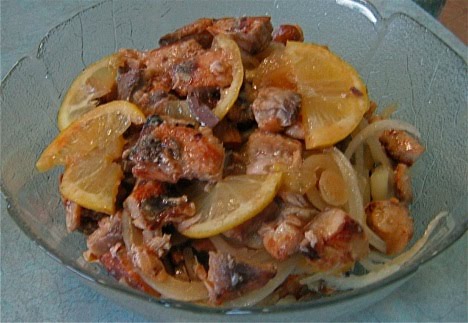
The recipe is to be served warm immediately or cold the next day, but I highly recommend the cold the next day option. The sugar from the vinegar, sake and the added sugar itself soaked into the lemon and kind of candied it. I wanted to keep eating lemon like a snack. Kind of like if lemonade came in fruit form. The fish was mild enough that the vinegar stuck out, and made a good pairing with the simple flavours of the Korean jap chae. Sesame didn't really go well with the fish, though, so I think a bowl of steamed rice would be a better idea. The noodles benefited from the vinegar, and I can't really complain about the fish. The other nice thing about waiting until the next day to eat the fish is that the fat solidifies and you can avoid it. Or you can eat it, or melt it over your rice or noodles. As you wish. I am far from traditional, and I apologize for that, but I don't think I messed the dish up horribly all things considered. The upside is now I'll know what the dish is when, or if, I see it on a menu. All in the name of cultural education...and dinner. Next time I see sea smelts...
Friday, April 23, 2010
Catch of the Day: Trout in Orange Sauce
I made it because I wanted to make a fish recipe from Josée di Stasio's A la di Stasio, of which there are only two, and I'd already made the other one twice. I didn't feel like shrimp or a salmon burger and there's something really beautiful about a simple fillet. I also felt like this might not be an orange disaster since US navel oranges are just on the end of their season now (by the time they ship to Newfoundland, that is. Everywhere else, the season is done apparently). They're so sweet and not very acidic. Simply put, they don't taste like tropicana.
Add butter, and you're golden. If I'd been in Toronto I would have bought black cod (aka sable fish or omble chevalier), since the flesh of the fish already tastes like butter, so you wouldn't actually need to add very much of the stuff to feel very French and fat. And happy.
4 150g trout fillets (or black cod if you can find it. Really, you can use any fish. Definitely any firm white fleshed fish, but salmon, trout or char are all good. Butter goes with everything. Maybe not the tuna you can get in Newfoundland, but a good fillet of a fattier tuna might be nice. Who knows?)
olive oil
salt and pepper
zest of 1 orange (or 2 if you use navel oranges and they don't give up much zest)
Juice of 3 oranges (1/2 cup. Mine were many pulpy, so it took quite a few)
2 tbsp fresh lemon juice
4 tbsp butter, in cubes
If you use a good quality butter you won't need more than this, but if your butter isn't the best, you may end up using more to try to salvage some flavour. Unsalted butter works well since you season with salt and pepper at the end.
Oven went to 425 Fahrenheit, and a baking sheet got lined with parchment paper (easy clean-up. No scrubbing fish bits off baking sheets. Kind of wasteful, but what you waste in paper you make up for in water so I figured I'd come out even).
Zest and juice oranges and juice lemon. Wash the fish in cold water and pat it dry with paper towels.
I used a brush to coat the fish in olive oil, but you can just drizzle it if you prefer. Painting it spreads the oil more easily without hurting the flesh of the fish with your hands. Then I sprinkled both sides with salt and freshly ground pepper. Skin on or off??? I went with on to keep the fish moister in the oven.
Then into the oven for 10 minutes. In the meantime, the citrus juices and zest got brought to a boil in a saucepan on high heat, and cooked for 1 minute (still on high heat to reduce the sauce). Then a little bit of salt and pepper to taste. Whisk in the butter. That was honestly all you had to do with the sauce. Orange juice, lemon juice, orange zest, boiled for 1 minute, add salt, pepper and butter. Genious.
These were thick fillets that didn't want to cook evenly, so after 10 minutes the ends were done, but the rest wasn't. I hate over-cooked fish, so I served the ends right away and put the rest of the fish back in for an extra 2 minutes. The hot sauce gets ladled over a fillet on each plate.
I even served the dish almost exactly as di Stasio recommended, mostly by accident. Basmati rice and bok choy. Well, pak choi. Close enough. The rice soaks up the extra sauce, so don't you dare add butter or salt to your rice. Plain is what the recipe needs. Same for the pak choi. In fact, the next night I steamed more pak choi and tossed it with the leftover orange butter sauce. It was perfect. It also made for a beautiful (un-photographed, sorry) plate, with the green of the vegetable leaves contrasting with the orange sauce. The freshly ground pepper made all the difference in the world, adding visual texture to the fish. So simple, so fresh. Just enough butter to taste rich, while being careful not to give too much sauce per plate. Rice should not swim in orange, and the trout had done enough swimming for its lifetime.